
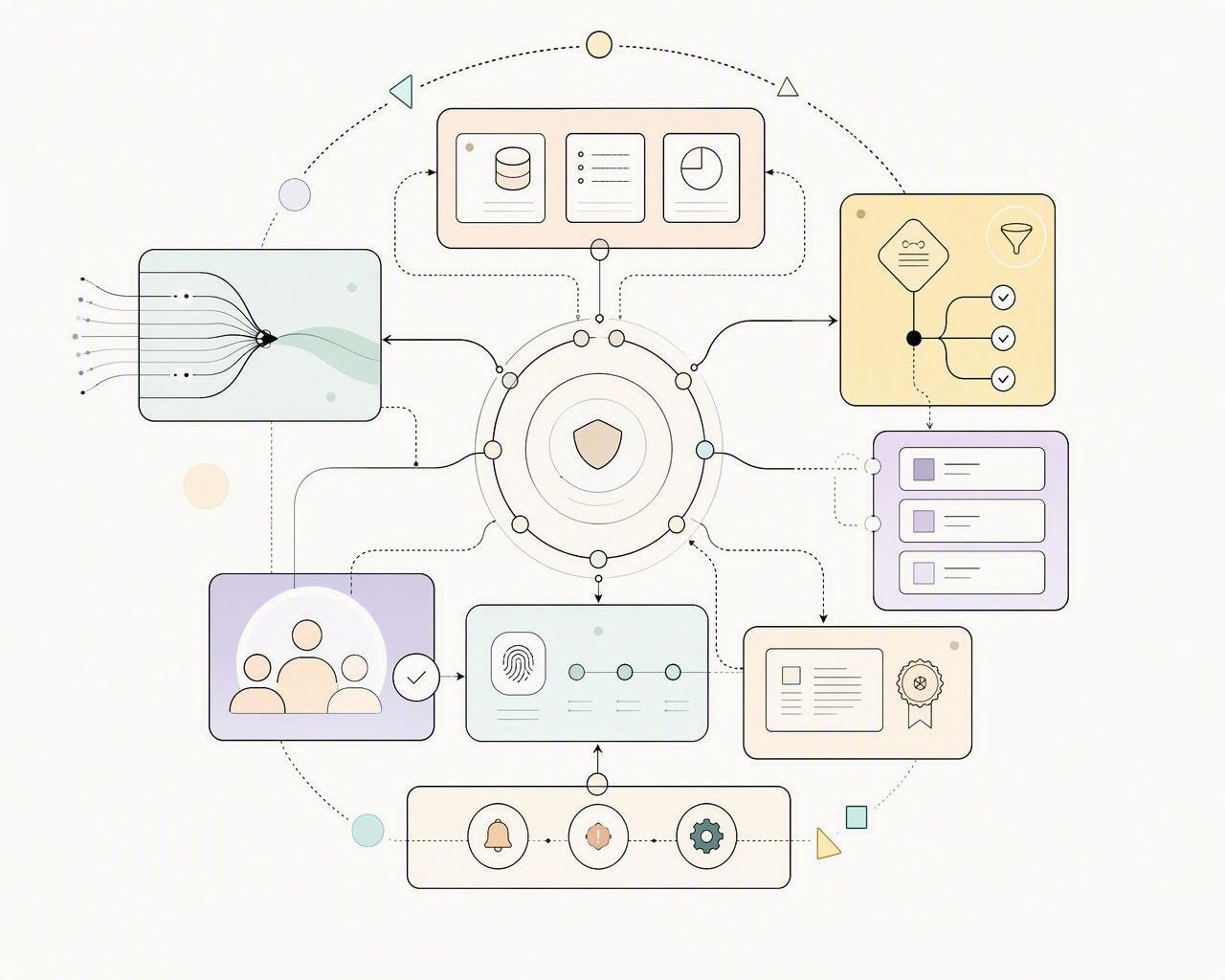
Turn privacy obligations into a programme your product, legal, security and operations teams can actually run
GDPR accountability is not a policy folder, a once-a-year training session, or a spreadsheet someone updates when a customer asks. It is the ability to explain—using current records—what personal data the organisation processes, why it does so, who is responsible, which suppliers are involved, how people can exercise their rights, and what happens when risk or processing changes.
This guide translates that requirement into operating work for SaaS teams. It is a practical field guide, not legal advice. GDPR applicability, lawful basis, international transfers, DPIA triggers, controller/processor roles and breach-notification decisions remain fact-specific matters for qualified privacy and legal review.
1. Accountability is the operating principle
The GDPR principles give teams the “what”: lawfulness, fairness and transparency; purpose limitation; data minimisation; accuracy; storage limitation; integrity and confidentiality; and accountability. Accountability is the principle that asks the organisation to demonstrate—not merely state—how it meets the others.
For a SaaS company, the practical test is straightforward:
Can someone outside the original meeting understand the processing purpose, lawful basis, systems, owners, vendors, retention, controls, decisions and evidence for a material processing activity?
If the answer depends on a single employee’s memory, the programme is exposed—even if the organisation has good intentions and sensible security controls.
2. Build the accountability chain: requirement → owner → action → evidence → review
The most useful way to operate privacy is as a chain of work. A requirement is identified, a person owns the response, the relevant team performs the work, evidence is retained, and the record is reviewed when conditions change.
The seven records every SaaS privacy programme needs
| Record | Minimum useful fields | Owner / review rhythm |
|---|---|---|
| 1. Processing inventory / ROPA | Activity, purpose, data subjects/categories, systems, recipients, transfers, retention, security measures, owner and evidence links. | Business owner updates; privacy validates; review on material change and on a defined periodic cadence. |
| 2. Purpose and lawful-basis record | Purpose, Article 6 basis, transparency text, decision rationale and any conditions. | Product/process owner with privacy/legal review. |
| 3. Data-flow and vendor record | Source, system path, recipient/processor, jurisdiction, contract reference, safeguards and owner. | Technical/data owner with vendor, procurement and privacy input. |
| 4. DPIA / high-risk decision record | Screening outcome, risk factors, affected groups, mitigations, approval and review trigger. | Privacy/legal with product, security and accountable risk owner. |
| 5. Rights-request record | Request type, identity verification, ownership, deadline, decision, response and exceptions. | Privacy/support/operations with legal escalation as needed. |
| 6. Incident and breach-decision record | Incident facts, data/people affected, risk assessment, notification decision, communications and corrective actions. | Incident lead, security and privacy/legal. |
| 7. Evidence and review history | Policies, approvals, control evidence, version history, findings, remediation and review decisions. | Privacy/GRC coordinates; owners maintain operating evidence. |
The records can live in different systems at first. What matters is that they have named owners, reliable links and predictable updates. A privacy programme becomes brittle when every record is recreated for each audit, buyer review or incident.
3. Start with the ROPA, but do not stop at the ROPA
A Records of Processing Activities (ROPA) is the working spine of the programme. It should be organised by processing activity, not simply by software application. A CRM, for example, may support distinct activities such as customer onboarding, account administration, marketing consent and support—each with a different purpose, data context, owner or retention expectation.
A practical ROPA entry template
| Field | Example: customer-support processing |
|---|---|
| Processing activity | Customer support and case resolution |
| Purpose | Resolve customer issues, maintain service quality and communicate operational updates |
| Data subjects / categories | Customer administrators and end users; name, email, account context, support request content |
| Business / system owner | VP Customer Success / Support-platform lead |
| Systems and recipients | Support platform, CRM and approved service providers involved in the workflow |
| Lawful-basis / privacy review | Record the applicable basis and rationale; obtain privacy/legal review where required |
| Retention | Defined support-case retention period and deletion/archive process |
| Transfers / safeguards | Identify relevant processor or cross-border transfer details and applicable review records |
| Security measures | Access controls, least privilege, logging and any relevant encryption/control evidence |
| DPIA flag | Yes/no with rationale and escalation trigger |
| Evidence links | Privacy notice, processor agreement, access-review evidence, retention record, DPIA or decision log |
| Change trigger | New data source, vendor change, new purpose, retention change, incident or higher-risk feature |
What good looks like: the entry tells a reviewer enough to ask intelligent questions without requiring a separate detective exercise through engineering diagrams, contracts and old emails.
4. Map data through the organisation once, then keep it alive
Data mapping is not an exercise in making a visually impressive diagram. It identifies what the organisation actually does: data collection, systems, transfers, recipients, retention and deletion. A static map becomes stale the moment a team adds a vendor, changes an API, introduces a new product feature or repurposes a data set.
A sensible first iteration
- Pick one business domain. Customer onboarding, support, HR/payroll or marketing are better first pilots than a rushed company-wide discovery project.
- Run technical discovery. Establish systems, databases, SaaS tools, integrations and operational logs that touch personal data.
- Run business discovery. Ask the people doing the work what they collect, why, who receives it, how long it is needed and what has recently changed.
- Create the processing record. Add Article 30 and practical accountability fields; do not leave owners, retention or evidence links for “later.”
- Trace flows and recipients. Confirm the operational route, including vendors, subprocessors, transfer context and deletion points.
- Flag risk and decisions. Identify entries needing DPIA, security, contractual, transfer or legal review.
- Validate and schedule maintenance. Have the business owner and privacy function agree the record is accurate enough to operate, then define change triggers.
The questions that uncover the real flow
- What personal data does this team collect or receive, and from whom?
- What business purpose needs it?
- Which systems, reports, integrations or vendors receive a copy?
- Who can access it, including support, administrators and service accounts?
- What makes the data more sensitive or the processing more consequential?
- What causes deletion, anonymisation, archival or a retention review?
- What product, vendor or process change should cause this record to be revisited?
5. Make DPIAs, vendors, rights and incidents real workflows
The privacy programme should use proportionate routes for high-risk decisions. A generic form that every product team fills out—and nobody reads—is compliance theatre. A missing path for a high-impact use case is worse.
DPIA / high-risk triage
Use a pre-change screening step. Escalate for privacy and legal review when processing may be high risk, including when it could involve sensitive data, systematic monitoring, significant automated decision-making, vulnerable groups, large-scale processing, novel technology or material effects on individuals. The exact legal determination must reflect the facts and applicable guidance.
The record should show:
- the use context and intended purpose;
- the data, affected groups and systems involved;
- anticipated risks and potential impacts;
- proposed controls and alternatives considered;
- decision-maker, residual-risk decision and follow-up date; and
- a trigger to revisit it if the processing or risk changes.
Vendor and transfer governance
A supplier’s assurance documentation is an input to your decision, not a substitute for it. Maintain a record of the processor or recipient, purpose, contract/DPA reference, relevant security or privacy review, data-flow context, transfer/safeguard review where applicable, decision and review date.
Rights requests
Build one clearly owned queue rather than allowing requests to wander through support inboxes. The workflow should record receipt, identity verification, request type, relevant data owners, deadline, decision/exemption rationale where applicable, response and closure. Legal or privacy escalation should be explicit for complex requests.
Incidents and breach decisions
The goal is not to decide every incident is a reportable breach. The goal is to retain a defensible decision record: what happened, which data and people were affected, the risk assessment, notification decision, responsible reviewers, communications and corrective actions. GDPR notification and communication duties are fact-specific; use qualified legal/privacy input.
6. Keep records current through operating triggers
The maintenance loop is the difference between a privacy programme and a discovery project.
| Trigger | Required action | Evidence to retain |
|---|---|---|
| New system, vendor or subprocessor | Update the processing and vendor/data-flow record; assess contract, transfer and risk implications. | Updated entry, review decision, contract/DPA/supporting records. |
| New purpose, feature or data category | Reassess purpose, lawful basis, transparency, minimisation and DPIA/impact need. | Change review, approval, updated notice/record where relevant. |
| Retention or deletion change | Confirm operational retention behaviour and record the rationale. | Retention decision, configuration/ticket and deletion evidence where applicable. |
| Rights request pattern or complaint | Assess whether the workflow, notice, data quality or product design needs improvement. | Request log, investigation and improvement action. |
| Security incident or vendor event | Run the incident/breach assessment and update any affected records. | Incident decision record, actions and approvals. |
| Periodic review | Test whether material records remain accurate, owned and linked to evidence. | Review report, version history and remediation items. |
7. Prepare an evidence pack someone else can review
Privacy teams do not need a hundred files for every buyer or internal audit. They need a structured way to show both design evidence and operating evidence.
A useful GDPR evidence pack
| Evidence group | Examples |
|---|---|
| Scope and accountability | Applicability/scope notes, role map, policy ownership, review cadence. |
| Processing records | ROPA, data-flow maps, lawful-basis/decision records, retention records. |
| Product and privacy by design | Change-review workflow, DPIA screening/assessments, approval and release records. |
| Vendors and transfers | Vendor inventory, processor agreements, privacy/security review, transfer/safeguard materials where relevant. |
| Rights and transparency | Privacy notices/version history, request workflow and de-identified log/metrics where appropriate. |
| Security and incidents | Relevant access/control evidence, incident response process, breach-decision records and corrective actions. |
| Review and improvement | Internal review, open findings, remediation, management decisions and version history. |
Keep disclosure proportionate. A customer security review may need a scoped assurance response; an internal review may need greater detail; a supervisory authority request may involve different legal obligations. Never make “share the entire evidence folder” the default workflow.
8. A 90-day GDPR accountability plan
Days 1–30 — establish visibility
- Confirm scope and appoint a privacy/accountability owner with an escalation route to legal and leadership.
- Select one business domain for the first processing inventory and data-mapping pilot.
- Create the ROPA schema, including owner, lawful-basis, DPIA flag, evidence and review fields.
- Identify the most material vendors, transfers, high-risk processing and existing rights/incident workflows.
Deliverable: an owner-backed first ROPA domain, a clear scope and a known gap list.
Days 31–60 — connect decisions and evidence
- Add data flows, vendors, retention, controls and evidence links to the priority records.
- Establish the privacy-by-design/DPIA screening route for material changes.
- Create a single accountable rights-request and incident/breach-decision workflow.
- Resolve the highest-risk gaps or document owned remediation plans.
Deliverable: living privacy records connected to the teams and systems that create the evidence.
Days 61–90 — review the programme as a reviewer would
- Test a selection of ROPA entries for accuracy, ownership, scope and evidence completeness.
- Rehearse a rights request and an incident/breach decision route.
- Review material vendors and high-risk processing with privacy, security, legal and leadership.
- Create the periodic review cadence and report open risks, decisions and resourcing needs.
Deliverable: a reviewable evidence pack, known exceptions and a real maintenance loop.
GDPR accountability checklist
- Processing activities—not just applications—are identified and owned.
- ROPA entries record purpose, data, systems, recipients, transfers, retention, security and evidence links.
- Lawful-basis, privacy notice and material decision records are current and reviewable.
- Product, vendor and process changes have a proportionate privacy/DPIA screening route.
- Rights requests and incident/breach decisions have named owners and a traceable record.
- Vendors, processors and relevant transfers are visible in the operating model.
- Privacy evidence can be packaged appropriately for a buyer, internal review or other request.
- Update triggers and periodic reviews keep the records current.
Make accountability maintainable
Ciphrix helps teams operationalise privacy work alongside broader compliance: AI agents support the execution of policies, evidence, controls and questionnaires, while expert humans guide implementation and retain legal, privacy, scope and risk decisions.
Book a demo to see privacy records, evidence and control workflows mapped to your actual systems.
Source notes
This guide synthesises Ciphrix’s published GDPR requirements guide, GDPR data mapping and ROPA guide, GDPR compliance audit guide, DPIA guide for privacy teams, continuous evidence collection guide and GDPR framework page. Confirm legal, regulatory, contractual and operational requirements against the applicable sources and the organisation’s own facts.