
Policies
Documented rules for security, access, data handling
ISO 27001 is the global standard for managing information security. It's required when customers, partners, or regulators need proof that your systems, data, and processes are secure.
For many companies, it becomes a blocker during enterprise deals, audits, or expansion into regulated markets.
This page explains what ISO 27001 involves and how companies typically get certified.
ISO 27001 is built around an Information Security Management System (ISMS). In practice, this means running a repeatable operating model, not collecting documents once.
Policies
Documented rules for security, access, data handling
Controls
Technical and operational safeguards (e.g., MFA, logging, encryption)
Risk management
Identifying and treating risks continuously
Evidence
Proof that controls are working (configs, logs, approvals)
Audits
External validation that your system meets the standard
It is not a checklist. It is a system that must reflect how your company actually operates.
Most companies go through the same lifecycle. Without a structured system, this work becomes manual, repetitive, and slow.
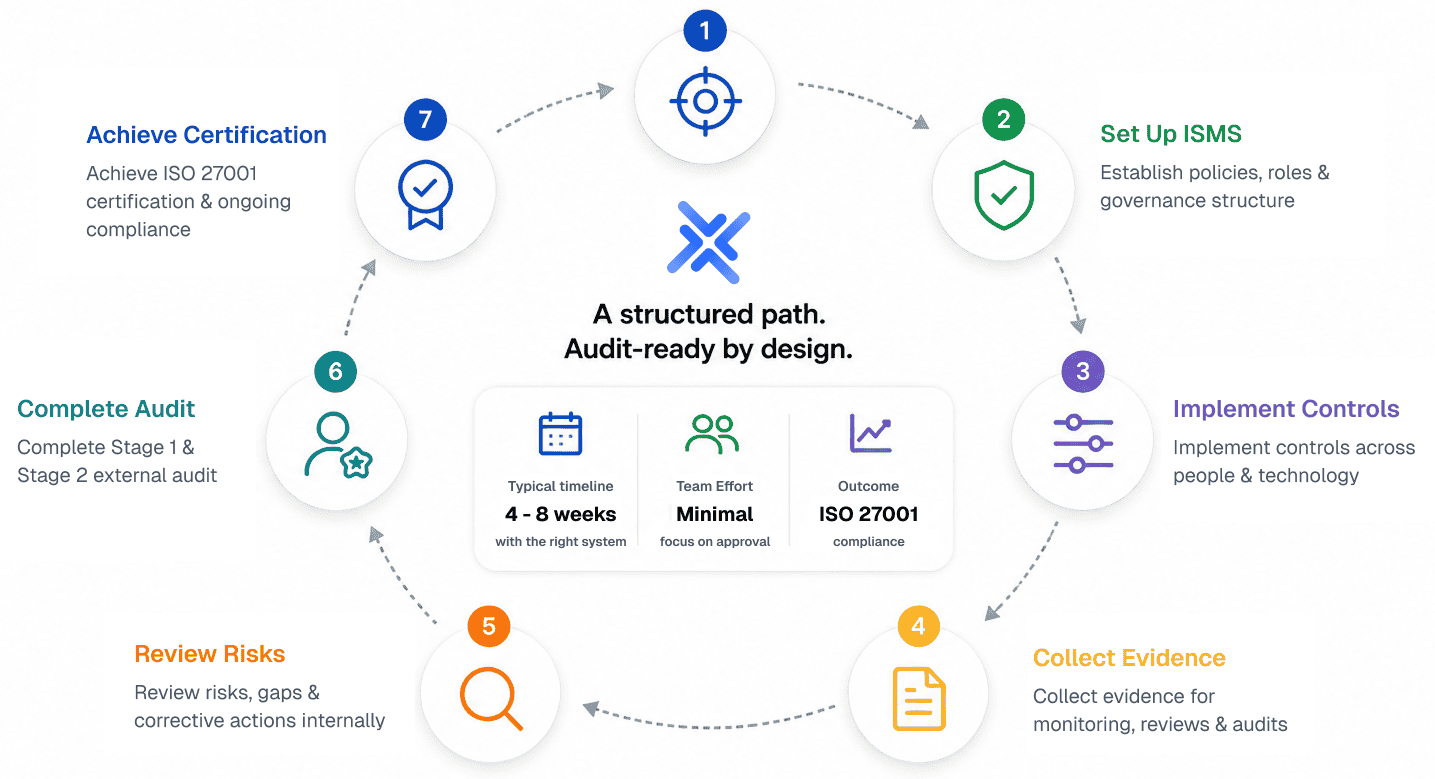
How companies approach ISO 27001 determines timeline, cost, and internal effort.
| Approach | Timeline | Cost | Internal Effort |
|---|---|---|---|
| Self-managed | 6-12+ months | Low upfront | Very high (founder / eng heavy) |
| Consultant-led | 3-6 months | High ($20K-$80K+) | Medium (coordination required) |
| Using Ciphrix | 4-8 weeks | Predictable SaaS cost | Low (system-driven) |
Key difference: Faster approaches do not reduce requirements. They reduce manual workload on your team.
What makes outcomes fast or slow is structure. The difference between a 6-month project and a 6-week outcome is how well execution is systemized.
Step 01
Controls are pre-mapped to ISO requirements.
Step 02
Policies are generated and adapted not written from scratch.
Step 03
Evidence is collected automatically from your systems.
Step 04
Gaps are identified continuously not at audit time.
Step 05
Everything stays aligned in one place across teams, controls, and evidence.
This removes the need to rebuild context across spreadsheets, docs, and disconnected tools.
Get a walkthrough of how companies go from zero to audit-ready in weeks.
Built by AWS Security Leaders | AWS Partner | Certified companies across 3 continents
Companies typically need ISO 27001 when:
It usually takes:
Costs vary based on approach:
Typical steps include:
Evidence includes:
Yes. AI can:
This reduces manual work and accelerates certification timelines.