
Criteria scope
Select applicable Trust Services Criteria
SOC 2 is an assurance framework for proving your controls protect customer data. It becomes critical during enterprise sales, procurement, and recurring security reviews.
For many SaaS and technology teams, SOC 2 pressure starts before internal compliance operations are mature, creating last-minute coordination across engineering, ops, and legal.
This page explains what SOC 2 involves and how teams move from setup to Type I or Type II readiness.
SOC 2 is built around the Trust Services Criteria. In practice, success depends on control ownership and reliable evidence, not static policy files.
Criteria scope
Select applicable Trust Services Criteria
Controls
Define controls for access, changes, incidents, vendors, and operations
Policies
Document governance procedures that explain control intent
Owners
Assign operation and evidence accountability for each control
Evidence
Collect proof from logs, tickets, approvals, and system records
Audit
Complete Type I or Type II review with an independent CPA firm
SOC 2 readiness is strongest when controls and evidence run as repeatable operations.
Most companies follow the same lifecycle. Without structure, SOC 2 work turns into spreadsheets, screenshots, and repeated auditor follow-ups.
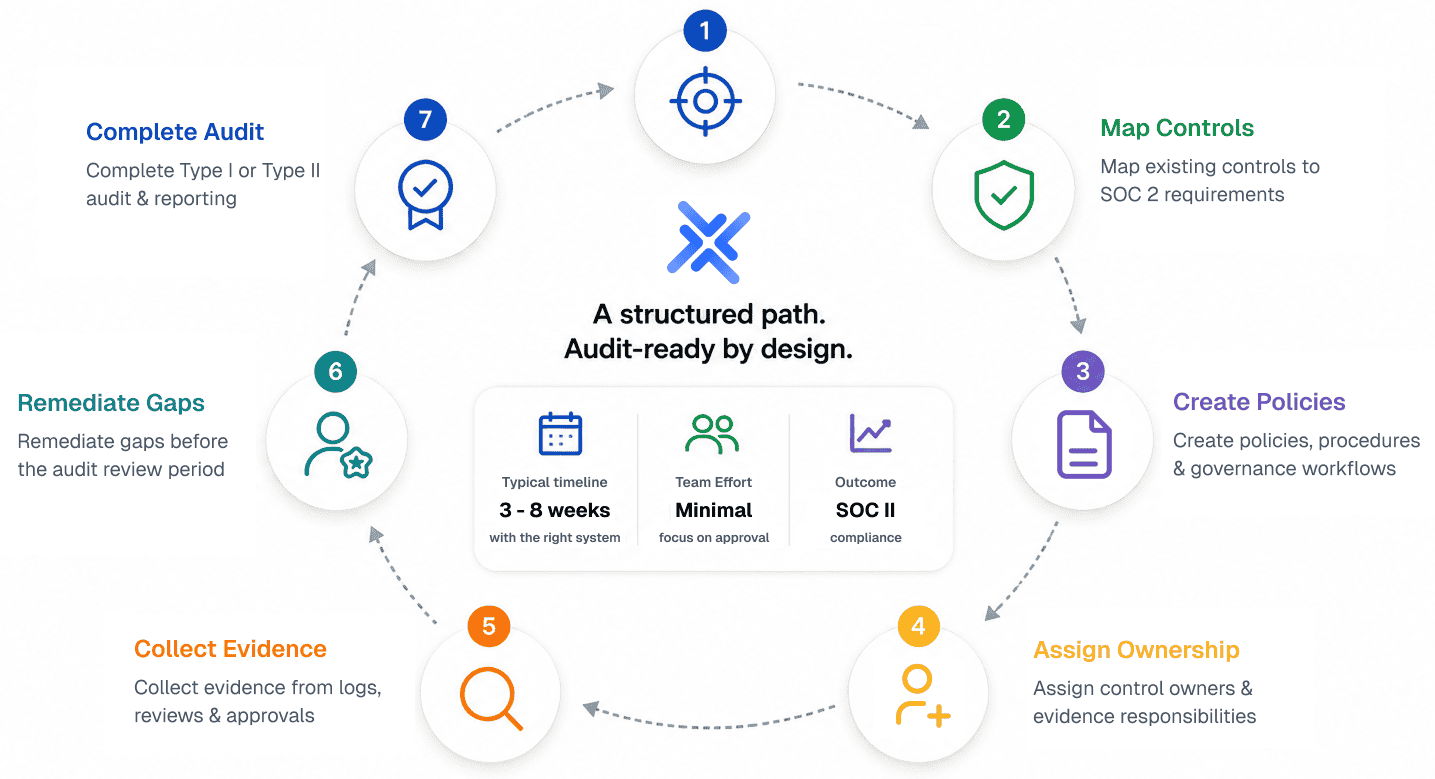
The approach you choose changes timeline, cost, and team workload.
| Approach | Timeline | Cost | Internal Effort |
|---|---|---|---|
| Self-managed | 6-12+ months | Lower cash cost, higher hidden cost | High |
| Consultant-led | 3-6 months | Higher services cost | Medium |
| Using Ciphrix | 4-10 weeks to readiness | Predictable platform cost | Lower, evidence-driven |
Faster SOC 2 execution does not change requirements. It reduces manual coordination.
SOC 2 moves faster when evidence collection is a system, not a periodic fire drill.
Step 01
Controls are mapped to relevant Trust Services Criteria.
Step 02
Policies are generated and adapted instead of drafted manually each cycle.
Step 03
Evidence is captured continuously from systems, workflows, and reviews.
Step 04
Gaps are identified early before fieldwork begins.
Step 05
Auditor requests stay organized with owners, due dates, and traceable proof.
This keeps SOC 2 work measurable, reviewable, and easier to sustain as you scale.
Get a walkthrough of how teams move from setup to audit-ready without manual evidence tracking.
Built by AWS Security Leaders | AWS Partner | Certified companies across 3 continents