
Administrative
Governance, risk analysis, workforce training, and formal procedures
HIPAA defines how protected health information should be handled across privacy, security, and breach response.
For health technology companies and vendors, readiness often becomes mandatory before healthcare contracts, vendor approvals, or regulated data expansion.
This page explains what HIPAA involves and how organizations build ongoing compliance, not one-time documentation.
HIPAA programs combine safeguards, governance, and evidence. In practice, teams need operational proof that controls and procedures are active.
Administrative
Governance, risk analysis, workforce training, and formal procedures
Physical
Facility, workstation, and device protections
Technical
Access controls, audit logs, integrity, and transmission security
Privacy
Rules for protected health information use and disclosure
Vendors
Business associate agreements and third-party oversight
Evidence
Proof for policies, training, reviews, incidents, and safeguards
HIPAA readiness is a living compliance program that must evolve with systems and data flows.
Most teams follow a similar path from PHI mapping to safeguards, evidence, and ongoing review as operations change.
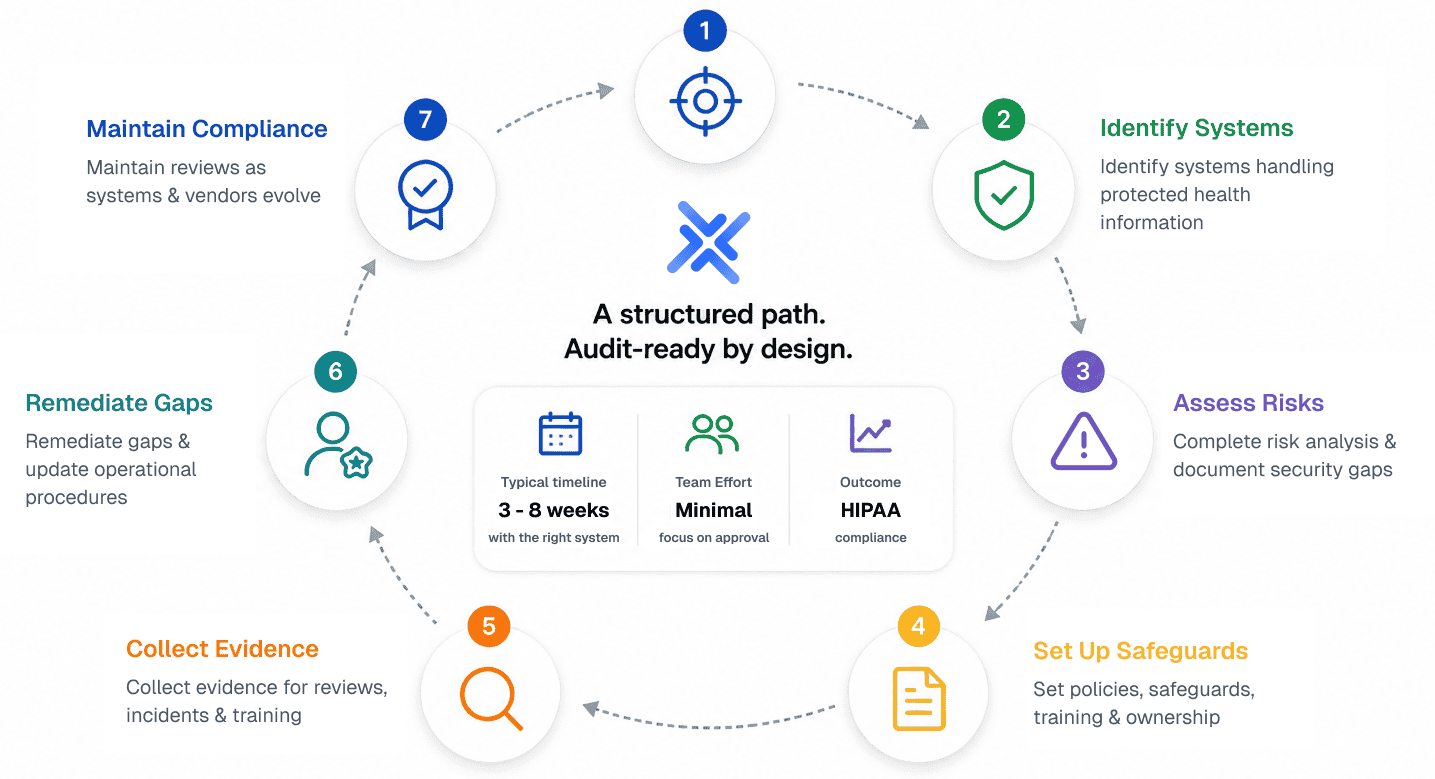
The implementation model determines speed, cost, and long-term maintenance burden.
| Approach | Timeline | Cost | Internal Effort |
|---|---|---|---|
| Self-managed | 3-9+ months | Lower cash cost, higher hidden cost | High |
| Consultant-led | 2-5 months | Higher services cost | Medium |
| Using Ciphrix | 3-8 weeks to readiness | Predictable platform cost | Lower, safeguards-driven |
Better systems do not reduce HIPAA obligations. They reduce manual trackingand coordination.
HIPAA becomes manageable when safeguards, risks, vendors, training, and evidence stay connected in one workflow.
Step 01
Safeguards are mapped to HIPAA requirements and responsibilities.
Step 02
Policies are generated and adapted to real healthcare workflows.
Step 03
Risk analysis stays linked to treatment actions and owners.
Step 04
Evidence is collected continuously from systems and operational reviews.
Step 05
Training, incidents, and vendor checks remain visible for audit and customer reviews.
This keeps HIPAA work auditable, current, and easier to sustain as teams and systems evolve.
Get a walkthrough of how healthcare-focused teams move from setup to operational readiness.
Built by AWS Security Leaders | AWS Partner | Certified companies across 3 continents