
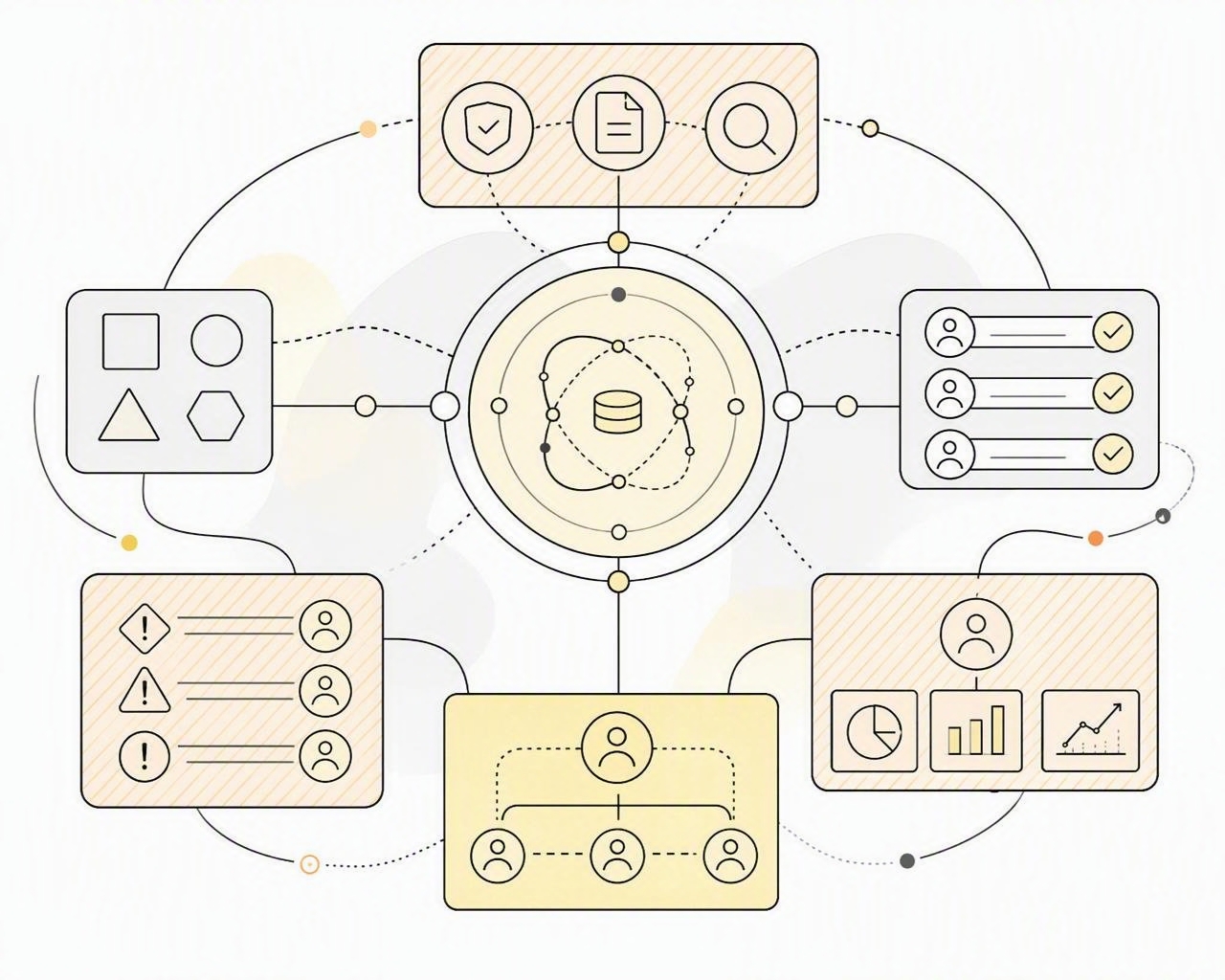
A field guide to running controls, evidence, exceptions and audit readiness — without turning compliance into a quarterly fire drill
Compliance does not fail because a team could not find another spreadsheet. It fails when nobody can answer, quickly and credibly: what is this control meant to achieve, who runs it, what proves it happened, and what happens when it does not?
This handbook is for the person who has been given the uncomfortable job of making compliance operational: the security or GRC lead, privacy owner, IT leader, founder, or operator responsible for an audit, an enterprise customer review, or a growing stack of frameworks. It is designed to be useful before you buy a platform.
The goal is not a perfect compliance programme. The goal is a working one: a programme that can see its important controls, collect proof near to the work, route exceptions to accountable people, and give leadership the information needed to make decisions.
1. Start with the operator’s test
Before selecting a framework, tool, or implementation partner, test the operating reality. For every important control, can the programme answer these seven questions?
- Objective: What risk or obligation does this control address?
- Scope: Which systems, people, data, vendors, or processes does it cover?
- Owner: Who is accountable for the control operating — not merely for uploading a file?
- Evidence: What record would show that it operated for the right scope and period?
- Cadence: When is the control checked, reviewed, or refreshed?
- Exception path: What happens when it fails, goes stale, or cannot operate as planned?
- Decision: Who can accept risk, change the control, or remove a blocker?
If the answer to more than two questions is “we’ll figure it out at audit time,” the programme is not yet operating. It is preparing to prepare.
Example: a control record that can be operated
A control record is not a policy title, an evidence folder, or a green status dot. It is a small operating contract between the people who run a system and the people who need assurance about it.
| Field | Example: production access review |
|---|---|
| Control objective | Only appropriate, approved users retain access to production systems. |
| Scope | Production AWS accounts and the privileged roles defined in the access policy. |
| Accountable owner | Identity and access-management owner. |
| Evidence source | Identity-provider export, HR status data, review ticket and reviewer approval. |
| Cadence | Event-driven for joiner/mover/leaver changes; periodic review according to policy and risk. |
| Reviewer | Security lead or assigned compliance reviewer. |
| Exception path | Ticket to IAM owner; remove access, correct record, or obtain time-bound risk acceptance. |
| Closure evidence | Retest result, ticket update, approval where relevant, and timestamp. |
Operator rule: a policy may describe the control. It does not demonstrate that the control operated.
2. Locate the programme you actually have
Most teams do not begin with nothing. They begin with a mixture: some reliable technical controls, some well-intentioned documents, some heroic people, and a growing number of evidence requests. That is a better starting point than pretending every programme is either “immature” or “audit-ready.”
Use this maturity lens to decide what to fix next, not to award yourself a score.
| Current reality | What you will observe | Most valuable next move |
|---|---|---|
| 1. Ad hoc / reactive | Evidence is gathered manually when an audit, deal, or incident approaches. | Scope the programme and appoint a central operator. |
| 2. Documented / repeatable | Policies and core controls exist, but operating proof is inconsistent. | Define owner, evidence and cadence for the important controls. |
| 3. Managed / risk-based | Risks are prioritised; controls and evidence are becoming traceable. | Standardise exception and remediation workflows. |
| 4. Monitored / integrated | Control health and ageing exceptions are visible between audits. | Improve source quality, test logic, cross-framework reuse and reporting. |
| 5. Continuous / optimised | Current evidence and risk trends inform routine decisions. | Tune signals, reduce friction and improve the controls that repeatedly fail. |
Do not skip from Level 1 to Level 5 by buying dashboards. A dashboard without named owners, understandable test logic and a remediation path is only a more polished way to discover that nobody has acted.
3. Build the minimum viable compliance operating system
The operating system has six connected parts: controls, owners, evidence, monitoring, exceptions and reporting. It is framework-agnostic by design. The exact requirements change across SOC 2, ISO 27001, HIPAA, GDPR, ISO 42001 and customer assurance reviews; the operating questions do not.
The six parts
| Part | The operator’s job | A useful output |
|---|---|---|
| Controls | Translate requirements into safeguards and repeatable procedures that make sense in the business. | A control record with an objective, scope and expected operation. |
| Owners | Assign someone who can act, not a generic department name. | An accountable owner, reviewer and escalation point. |
| Evidence | Define the source, period, scope and review expectation before collection begins. | A linked, dated evidence record rather than an orphaned file. |
| Monitoring | Choose a risk-based rhythm for tests, reviews and freshness checks. | A known cadence and visible control status. |
| Exceptions | Turn failures into owned work with a decision path. | A ticket, remediation plan, approved exception or risk acceptance. |
| Reporting | Give leaders material risk and blockers, not a wall of compliance activity. | A decision-focused readiness view. |
Choose an operating model deliberately
There is no universally correct structure. Choose based on where authority, expertise and systems reside.
- Centralised: one small team owns programme coordination and most execution. It works well for a single-jurisdiction or less complex organisation, but can become a bottleneck when every evidence request runs through one person.
- Decentralised: embedded teams own local requirements and controls. It suits diverse regions or business lines, but needs strong common standards to avoid fragmented evidence and inconsistent risk decisions.
- Centre of excellence: a central team sets method, controls, evidence standards and reporting; local teams execute. It is often the most practical model as a technology company grows.
Whatever the model, avoid the false comfort of “GRC owns compliance.” GRC can coordinate. The team operating production access, vendor onboarding, payroll, incident response or a data-processing workflow must own the work that proves its controls.
Stakeholder commitments, not generic buy-in
Ask each stakeholder for a visible, recurring commitment.
| Group | Commitment that matters | Evidence of buy-in |
|---|---|---|
| Executive sponsor | Resolve material trade-offs and review readiness/risk. | Decisions, funding and blockers captured in a regular review. |
| Security / GRC | Define expectations, challenge gaps and coordinate reporting. | Current control register and escalated risks. |
| Engineering / IT | Maintain technical controls and remediate system exceptions. | Completed tickets, traceable changes and current source evidence. |
| Legal / privacy | Interpret obligations and review material exceptions early. | Documented decisions and reviewed policy/data-flow changes. |
| Procurement / business owners | Run vendor and process controls in normal workflows. | Current reviews, contracts and owner acknowledgements. |
If requests are continuously late, owners cannot explain their responsibility, and remediation moves only after executive escalation, this is not an “engagement issue.” It is a design issue in the operating model.
4. Make evidence useful before it is requested
Evidence collection should begin with a proof question, not a file request. Ask: what would a skeptical reviewer need to see to understand that this control operated for the relevant population, system and period?
The evidence acceptance test
Before marking an item complete, check all six dimensions:
- Relevant: Does it support this specific control or requirement?
- In scope: Does it cover the system, population, vendor, product or geography being assessed?
- Current: Is it dated appropriately for the audit period or review cadence?
- Provenanced: Can a reviewer identify the source system, report or workflow that produced it?
- Reviewable: Can someone other than the preparer understand what it shows, who reviewed it and why it is sufficient?
- Exception-aware: Does it include known gaps, exclusions, compensating controls or follow-up work where these matter?
The difference is material. “AWS screenshot, final.png” is a file. “Cloud configuration report exported from the named account on 12 June, reviewed by the platform lead against the defined baseline, with the exception ticket attached” is evidence a reviewer can work with.
Map the evidence chain
For each priority control, retain the relationship between requirement, control, risk, evidence and test. That relationship lets a programme reuse work thoughtfully across frameworks without assuming that one document automatically satisfies every assessment.
| Link | Operator question |
|---|---|
| Requirement → control | What does this framework, contract or obligation expect in practice? |
| Control → risk | What failure is this control reducing? |
| Control → evidence | What shows the control was designed and operated? |
| Evidence → test | Who checks it, how often, and against what acceptance standard? |
| Test → exception | What happens if the proof is missing, stale or inconsistent? |
This is the foundation for multi-framework programmes. Reuse the underlying operational fact where it genuinely overlaps; preserve the framework-specific context, scope and testing requirement around it.
5. Turn monitoring into a response loop
Not every control needs real-time monitoring. A practical programme chooses cadence based on risk, change frequency and the reliability of the source. Access changes may need an event-driven check; policy acknowledgement may require a periodic report; incident response is necessarily event-driven.
Choose the first controls to operationalise
Start with controls that are all or mostly:
- material to security, privacy, contractual or operational risk;
- owned by someone who can remediate a failure;
- backed by an authoritative enough source system;
- measurable through a rule, reconciliation, review or exception condition;
- able to produce an actionable exception; and
- painful to evidence manually today.
Good early candidates are often privileged access, leaver access, MFA coverage, cloud configuration, critical vulnerability remediation, production-change traceability, backup evidence, vendor reassessment, policy acknowledgement and security training. A judgement-heavy control with ambiguous ownership and weak data can be important, but it is usually a poor first monitoring pilot.
Worked example: access control from objective to closure
| Step | A workable design |
|---|---|
| Objective | Only approved people retain appropriate access to a critical environment. |
| Source data | Identity provider, HR system, target application and approval/ticket workflow. |
| Test logic | Active access must map to a current employee, approved service account or documented exception. |
| Cadence | Event-driven change check plus the periodic review required by policy and risk. |
| Exception rule | Terminated, unknown or unapproved privileged access opens a tracked item. |
| Owner | IAM owner or first-line system owner. |
| Resolution | Remove access, correct mapping, or obtain a time-bound approved exception. |
| Closure proof | Retest result, source reference, ticket, action/approval and timestamp. |
The purpose of the workflow is not to claim an audit conclusion automatically. It creates a current, explainable control signal and the evidence of how the team responded to it.
6. Treat exceptions as managed work
An exception is not a red mark to be hidden before an audit. It is the place where a programme proves it can see a problem, make a risk decision and follow through. That is more credible than a control register that claims everything is green.
The exception decision path
- Detect: identify stale evidence, a failed test, missing approval, drift or another condition that calls the control into question.
- Triage: establish the scope, risk, time period and whether the signal is valid.
- Assign: route it to the person or team able to change the system or process.
- Decide: remediate, apply an approved compensating control, or accept risk through the right authority.
- Verify: attach proof that the correction worked, or retain the approval and expiry conditions for an accepted exception.
- Learn: identify repeated failures, unclear logic or missing ownership and improve the programme.
A usable exception register
| Field | Why it exists |
|---|---|
| Control and affected scope | Makes the issue traceable to the actual operating context. |
| Description and discovery date | Lets a reviewer understand what happened and when. |
| Severity and rationale | Supports prioritisation rather than treating every issue equally. |
| Accountable owner | Identifies who can move the work forward. |
| Remediation or compensating action | Shows the selected response. |
| Due date and escalation | Makes ageing visible before it becomes an audit surprise. |
| Verification evidence | Demonstrates completion, not merely assertion. |
| Risk acceptance / expiry | Captures the authority and limits of a decision not to remediate immediately. |
What good looks like: a high-risk exception has a named owner, a decision-maker, a next date and a verification plan. It does not disappear because an auditor has not asked for it yet.
7. Give leadership a decision view, not an activity report
Senior leaders should not have to decipher hundreds of evidence tasks. They need a view that tells them where risk remains, what is blocking readiness, and what action needs their authority.
A weekly operator dashboard
| Measure | Question it answers | Escalate when |
|---|---|---|
| Critical controls with current evidence | Are the controls that matter most presently provable? | Evidence is stale, missing or contested for a material control. |
| Open exceptions by severity and age | Where is risk accumulating? | A high-severity issue is past its commitment or has no owner. |
| Remediation completion and verification | Are fixes actually closing? | Work closes without proof, or the same failure recurs. |
| Ownership coverage | Can every priority control be operated by somebody accountable? | A control or evidence source is orphaned. |
| Framework / customer readiness | Which commitments are at risk of slipping? | A deadline is dependent on unresolved scope, evidence or risk decisions. |
| Repeated evidence friction | Where are people rebuilding the same proof? | Teams repeatedly provide duplicated files or manual screenshots. |
The operator’s job is to turn these signals into a short agenda: “approve this risk acceptance,” “unblock this engineering owner,” “confirm this framework scope,” or “fund this source-system integration.”
8. Launch the operating model in 90 days
Use the first quarter to make the programme credible, not comprehensive. Start where risk, commercial pressure and evidence pain meet.
Days 1–30 — establish the foundation
- Confirm scope: framework(s), in-scope services, key data, target audit/customer milestones and exclusions.
- Name an executive sponsor and one central programme operator.
- Identify the first ten to twenty material controls; do not begin with every line of every framework.
- Create a control record for each priority control and map the evidence sources.
- Triage policy and evidence gaps; immediately assign critical and high-severity issues.
- Agree the weekly readiness review and escalation route.
Deliverable: a scope note, owner-backed control register, first gap list and a functioning programme cadence.
Days 31–60 — run the loops
- Collect and assess current evidence against the acceptance test.
- Pilot monitoring for a small number of data-backed, high-change controls.
- Convert discovered gaps into owned remediation or approved risk decisions.
- Introduce one repeatable source-of-truth path for every evidence type where possible.
- Prepare a concise leadership dashboard; remove duplicate requests and unclear ownership.
Deliverable: evidence linked to controls, a live exception workflow and a clear view of remaining readiness risk.
Days 61–90 — prove the programme can be reviewed
- Run a mock evidence review with someone who did not assemble the package.
- Test whether each item meets relevance, scope, time, provenance, review and exception criteria.
- Verify closure evidence for material remediation.
- Document medium-term actions for gaps that cannot close immediately.
- Confirm what auditors, customers, leadership or implementation partners need next — and who answers.
Deliverable: a reviewable package, known exceptions and an operating model that survives beyond the immediate deadline.
In the field: execution without losing delivery momentum
Bheja AI needed structured compliance around sensitive financial data without slowing product and engineering delivery. In its published Ciphrix case study, the team reached an audit-ready posture in six weeks, reduced manual compliance effort by around 90%, and maintained normal product and engineering velocity.
The useful lesson is not the number of weeks. It is that controls, evidence, ownership and review were operated as one connected system rather than rebuilt as a one-time document project.
A final operator checklist
Before you call the programme “ready,” make sure you can say yes to these statements:
- Our scope is explicit, including systems, data, people, vendors and frameworks.
- Every priority control has an objective, owner, evidence source and cadence.
- Evidence is linked to controls and is current, scoped and reviewable.
- We can see which exceptions are open, ageing and blocked.
- High-risk exceptions have decisions, owners and verification plans.
- Leadership receives a short, decision-focused readiness view.
- We know which controls should be monitored or automated next — and why.
- We have rehearsed the experience of a reviewer asking for evidence.
Make the model real in your own environment
The handbook gives you the operating model. Ciphrix helps teams put it into practice: AI agents perform real compliance work across policies, evidence, controls and questionnaires, while expert humans guide implementation and retain accountable decisions.
Book a demo to see your real Ciphrix compliance workspace and the path to 50% completion in 20 minutes.
Source notes
This handbook synthesises Ciphrix’s published guidance on continuous compliance strategy, continuous compliance maturity, continuous control monitoring, building a compliance team, stakeholder buy-in, audit readiness, continuous evidence collection and control mapping. Framework-specific requirements and assessment approaches should be confirmed against the applicable standard, contractual terms and assessor guidance.