
The operating model for teams that cannot afford to treat compliance as a side project
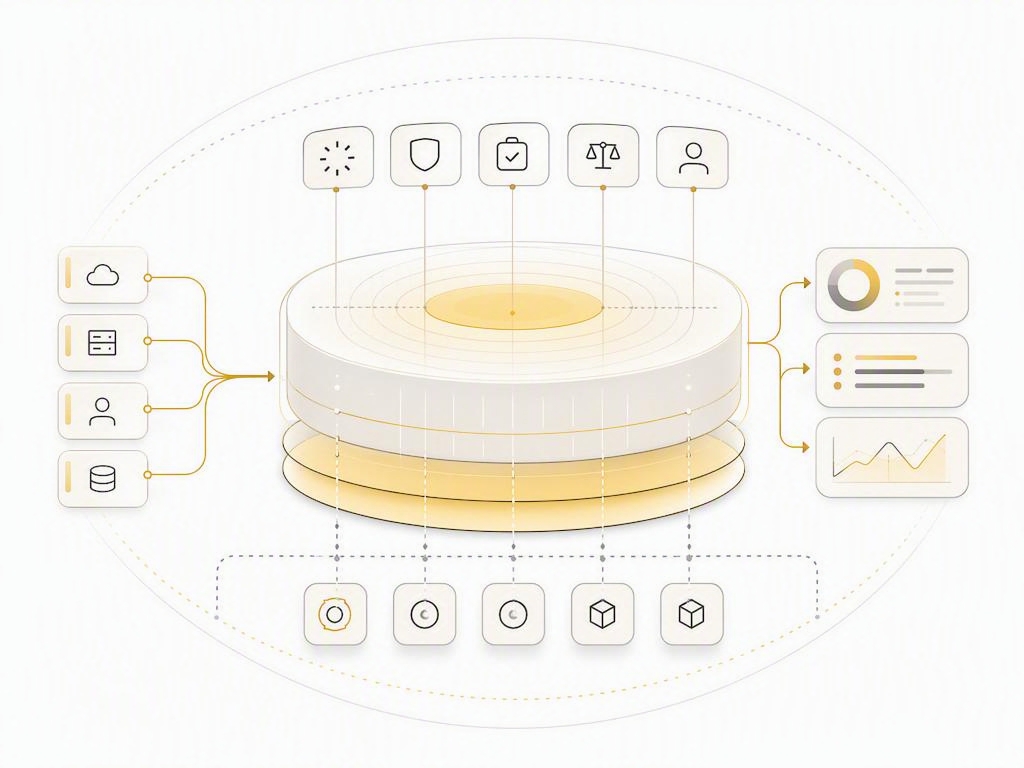
A connected compliance system carries context forward. Teams do not need to reconstruct the same information for every framework, review, or audit request.
For years, compliance software has promised to make compliance easier. And it has - up to a point.
It has replaced some spreadsheets. It has centralised a policy library. It has made controls easier to assign and audit requests easier to track.
But for most teams, the hard part has remained untouched: someone still needs to understand the business, draft the policy, assess the risk, find the evidence, chase an owner, answer the questionnaire, interpret an exception, and prepare the audit trail.
That is not a software problem alone. It is an operating-model problem.
An AI-native compliance programme changes the division of work. AI agents perform repeatable, context-heavy tasks across policies, risk, evidence, and customer assurance. Human owners retain the decisions that require accountability: determining scope, accepting risk, approving policy, resolving exceptions, and standing behind the programme.
The result is not "compliance without people." It is compliance without unnecessary coordination.
The core idea
A modern compliance programme should behave like an operating system: one connected source of context, controls, evidence, decisions, and accountability - not a collection of documents that must be rebuilt whenever an auditor or enterprise buyer asks a question.
Why compliance becomes a drag on growing companies
The first version of a compliance programme is usually built under pressure. A major customer asks for SOC 2. A board member asks how AI is governed. A healthcare opportunity requires privacy evidence. An investor asks whether ISO 27001 is on the roadmap.
The organisation reacts. It opens a tracker. It buys templates. It books a consultant. It distributes a list of evidence requests across engineering, IT, HR, legal, finance, and security.
The problem is not that any of these actions are wrong. The problem is that they create a temporary project around work that must become permanent.
When the programme is disconnected, the same facts are entered repeatedly:
- a system description in one document;
- a control in another;
- a risk in a spreadsheet;
- an access review in an identity tool;
- a vendor answer in an old questionnaire;
- a policy approval in email;
- a finding in a ticket;
- an auditor request in a shared folder.
The organisation can be doing the right things and still be unable to show it quickly. That gap between operational reality and provable reality is where audit panic, delayed deals, and compliance fatigue begin.
The three generations of compliance operations
Generation one: the compliance project
The programme lives in documents, spreadsheets, meetings, and the memory of the person coordinating it. Work accelerates before an audit and slows after it. The same evidence is collected again because nobody is certain which version is current.
This model can get a determined team through a first milestone. It does not scale gracefully across frameworks, customers, or change.
Generation two: workflow automation
The platform centralises controls, tasks, policies, and integrations. This is a meaningful improvement. Teams gain visibility, reminders, and a better audit trail.
But visibility is not execution. If the programme still relies on people to assemble company context, draft every first version, locate every answer, and coordinate every evidence request, the central bottleneck remains.
Generation three: AI-native compliance
The system has a shared model of the organisation: its frameworks, systems, risks, controls, owners, policies, evidence, and open actions. AI agents use that context to perform repeatable work, while people review and govern the output.
The practical shift is simple:
| Old question | AI-native question |
|---|---|
| Who will write the first policy draft? | What company context should the Policy Agent use, and who approves the output? |
| Who can chase this evidence? | Which source system holds it, how often should it refresh, and who reviews exceptions? |
| Who answered this questionnaire last time? | Which approved answer and supporting evidence apply to this question now? |
| Which spreadsheet contains this risk? | Which systems, controls, owners, and decisions are connected to this risk? |
The difference is not a new dashboard. It is a shared operational model that connects a requirement to the control, risk, evidence, test, owner, and review that make it defensible.
The Ciphrix operating model
At Ciphrix, the programme is designed around five connected loops.
1. The policy loop: turn context into an approved way of working
Policies should describe how the organisation actually operates. A policy that is copied from a template but cannot be followed creates audit risk rather than reducing it.
An AI-native approach starts with company context - systems, scope, teams, frameworks, and operational practices - to generate a working first draft. The policy owner then reviews, changes, and approves it. The important distinction is that the human owner remains accountable for the policy; the system removes the blank-page work and preserves the approval trail.
What good looks like: a current policy linked to the controls it supports, the owner who approved it, the people expected to follow it, and the evidence showing the process operates.
2. The risk loop: make decisions traceable
Risk work becomes fragile when it is a one-off workshop followed by a forgotten register. A useful risk record connects a scenario to its affected systems, existing controls, treatment decision, owner, due date, and review history.
AI can accelerate the discovery and assessment work: it can use organisational context to identify relevant risks, draft initial analysis, suggest a control relationship, and identify missing information. It should not silently accept a risk or substitute for the person authorised to make that decision.
What good looks like: a leadership team can see which material risks are open, what treatment has been agreed, where the evidence lives, and what needs a decision.
3. The evidence loop: collect proof close to the work
Audit evidence is not a folder of screenshots. It is the traceable record that a control was performed, during the relevant period, by the right process and with an accountable owner.
In an AI-native model, evidence is collected from the systems where work happens - identity platforms, cloud environments, source control, ticketing, HR systems, monitoring tools, and approved repositories. It is mapped to the relevant controls, checked for coverage and currency, and routed for owner review when something is incomplete or ambiguous.
This is why continuous collection matters. It makes the programme reflect the current operating state, rather than an emergency reconstruction of a past state.
What good looks like: an auditor can follow a control to a current evidence source, understand the period it covers, see who reviewed it, and identify any exception without an email chain.
Evidence becomes more useful when it is mapped to controls and reviewed in context, rather than stored as an isolated file.
4. The assurance loop: answer buyers with approved evidence
Enterprise security reviews are not merely a sales inconvenience. They are an external test of whether the company can explain its operating model with confidence.
The Answer Agent uses the approved compliance environment - policies, controls, evidence, and prior reviewed responses - to prepare security-questionnaire answers. The responsible person reviews the answer before it is sent. That prevents the two familiar failure modes: rewriting the same response from scratch, or copying an old answer that is no longer true.
What good looks like: customer answers are consistent, scoped, reviewed, and accompanied by the appropriate supporting evidence without exposing more than the customer needs to see.
5. The improvement loop: keep the system honest
Every programme produces exceptions: an overdue access review, an evidence gap, a failed check, a supplier that needs reassessment, a policy that no longer matches how the team works.
The goal is not to hide those gaps. It is to make them visible, assign them to someone who can act, track remediation, and retain proof of closure. This is how the system becomes more trustworthy after each audit, customer review, or internal finding.
The human-accountability line
The most important design decision in an AI-native programme is knowing where automation stops.
| AI agents can help with | Accountable people must own |
|---|---|
| Drafting policies from approved company context | Policy approval and confirmation that practice matches the policy |
| Identifying risk inputs and preparing analysis | Risk acceptance, treatment choice, and prioritisation |
| Collecting, mapping, and flagging evidence | Sufficiency judgement and exception approval |
| Preparing questionnaire answers from approved data | Final response approval and disclosure judgement |
| Packaging audit materials and tracking requests | Management assertion, control operation, and auditor interaction |
This is not a caveat. It is the reason the model is defensible. Fast work is valuable; accountable work is essential.
What a 90-day reset can look like
Every programme starts from a different point. Scope, engineering maturity, framework requirements, and audit timing all matter. Still, the sequence is consistent.
Days 1-30: establish the source of truth
- Confirm the business objective and in-scope service.
- Connect the systems that hold operational evidence.
- Establish initial policies, risks, controls, framework mapping, and owners.
- Identify the gaps that require real operational change.
Days 31-60: make the programme operate
- Turn evidence collection into a recurring workflow.
- Review and approve policies, risk treatment, and control ownership.
- Close high-priority readiness gaps.
- Set a clear exception and remediation path.
Days 61-90: demonstrate readiness
- Test the evidence trail with an internal audit or readiness review.
- Prepare the auditor or customer-assurance view.
- Review material risk, open actions, and programme status with leadership.
- Create the operating cadence for the next quarter.
The outcome is not a claim that every company will be certified in 90 days. It is a programme that is structured, visible, and materially easier to assess and improve.
In the field: execution without losing velocity
Bheja AI needed structured compliance around sensitive financial data without slowing product and engineering delivery. In its published Ciphrix case study, the team reached an audit-ready posture in six weeks, reduced manual compliance effort by around 90%, and maintained normal product and engineering velocity.
The useful lesson is not the number of weeks. It is the operating choice behind it: policy, controls, ownership, and continuous evidence collection were built as a connected system rather than a one-time document project.
Vern reached ISO 27001 certification in four weeks without external consultants. Its story reinforces a related lesson: implementation speed comes from clear scope, disciplined execution, and a system that keeps the work connected. It is a customer outcome, not a universal timeline.
A practitioner perspective
Ciphrix was built by former AWS security leaders who have worked across cloud, enterprise security, compliance operations, engineering, and regulated environments. Ash Kumar brings 20+ years across cybersecurity, AWS, Accenture, and Sun Microsystems. Anish brings security, compliance, and engineering experience across AWS, Visa, and HSBC.
The point of view in this guide comes from that operating experience: compliance cannot be reduced to a checklist, and AI should not be reduced to a chatbot. The durable advantage comes from connecting real work, real evidence, and real accountability.
See the model in your own environment
If your team is preparing for SOC 2, ISO 27001, HIPAA, GDPR, ISO 42001, or a multi-framework programme, Ciphrix can show how the operating model applies to your actual scope and systems.
Book a demo to see a real Ciphrix workspace reach 50% completion in 20 minutes.
Sources and further reading
- Ciphrix framework material: ISO 27001 and ISO 42001
- SOC 2 Trust Services Criteria guide
- NIST AI Risk Management Framework guide
- GDPR requirements guide
- Ciphrix resources: continuous evidence collection, control mapping, SOC 2 evidence collection, security questionnaire automation and AI governance
- Ciphrix customer stories: Bheja AI and Vern