

Compliance used to mean one thing: pain. Months of spreadsheets, endless email chains, expensive consultants, and a scramble to gather evidence before an auditor showed up. For companies moving fast, that pace isn't just frustrating. It's a competitive liability.
Think about what's actually at stake. A promising enterprise deal stalls because the prospect's security team wants your SOC 2 report. A fundraising conversation slows down because investors want to see ISO 27001 certification. A market expansion hits a wall because GDPR compliance isn't in place. In each of these scenarios, compliance isn't a legal checkbox. It's a growth blocker.
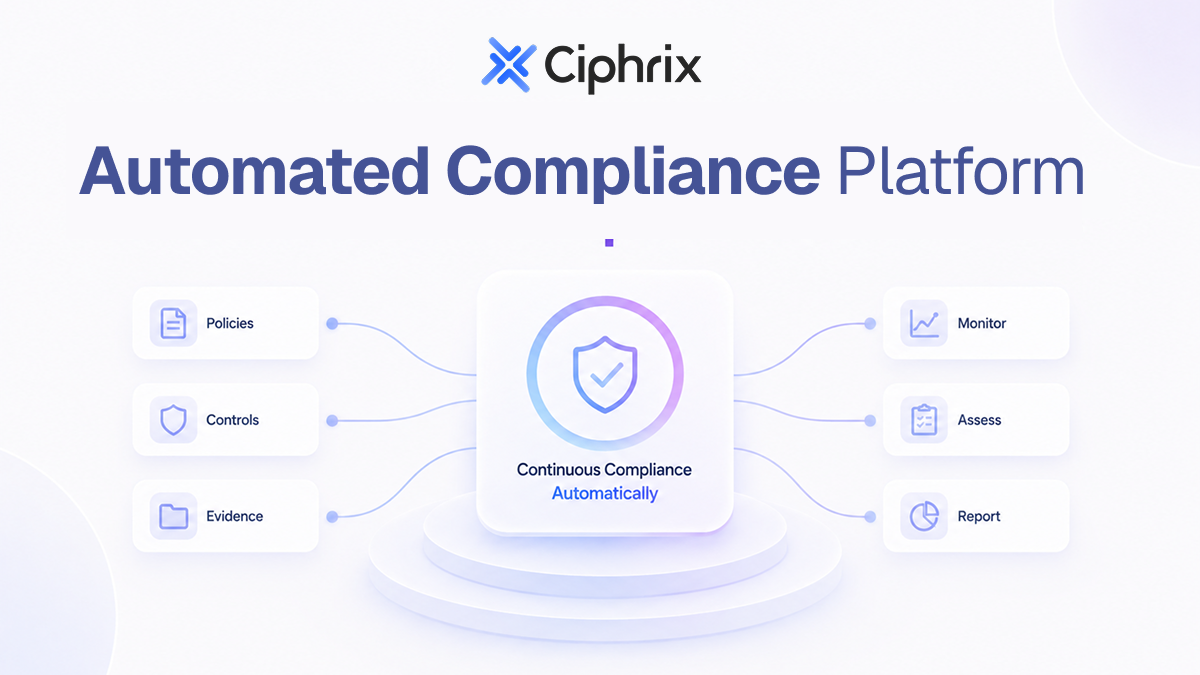
That's the problem an automated compliance platform is built to solve. Instead of treating compliance as a periodic scramble, these platforms turn it into a continuous, software-driven process: evidence collected automatically, controls monitored in real time, policies kept current, and audit documentation ready when you need it.
This article breaks down exactly how automated compliance platforms work, what they actually automate, who gets the most value from them, and what to look for when evaluating one. We'll also explain how Ciphrix takes this a step further with AI agents that don't just automate tasks but actively do the compliance thinking on your behalf. If you've been wondering whether there's a better way to approach certifications like SOC 2, ISO 27001, or HIPAA, the answer is yes. And it looks very different from the old way.
The Old Way vs. The New Way: Why Manual Compliance Is Broken
Picture the traditional compliance process. A company decides it needs SOC 2 certification to close enterprise deals. They bring in a consultant, spend weeks mapping out controls, assign team members to manually gather evidence from a dozen different systems, and track everything in a shared spreadsheet that's out of date the moment it's created. Six months later, maybe twelve, they're finally audit-ready.
This isn't a worst-case scenario. For many companies, this is simply how it goes. Manual compliance is inherently slow because it relies on human effort at every step: someone has to pull logs from AWS, export user access records from Okta, confirm that vulnerability scans ran on schedule, and document all of it in a format an auditor will accept. Multiply that effort across dozens of controls and multiple frameworks, and you start to understand why compliance teams burn out and timelines slip.
The core problem isn't just inefficiency. It's that manual processes are point-in-time by nature. You gather evidence for an audit window, pass the audit, and then the compliance posture slowly drifts until the next cycle begins. Auditors and enterprise buyers are increasingly aware of this dynamic, and many now expect continuous compliance evidence rather than a snapshot taken right before the audit.
For fast-growing companies, this creates a compounding problem. Compliance becomes a bottleneck that blocks enterprise deals, delays fundraising conversations, and slows expansion into regulated markets. Meanwhile, the engineering and security teams responsible for compliance work are also responsible for building the product, responding to incidents, and managing infrastructure. There's no slack in the system.
Automated compliance platforms address this at the root. Instead of relying on humans to collect, organize, and maintain compliance evidence, these platforms connect directly to the tools a company already uses and pull that evidence automatically. Controls are monitored continuously, not periodically. Gaps are flagged in real time, not discovered during an audit prep sprint.
The shift is conceptual as much as it is technical. Manual compliance treats certification as a destination: you work toward it, achieve it, and then start over. Automated compliance treats it as a continuous state: your environment is always being monitored, always producing evidence, always ready. That's a fundamentally different relationship with compliance, and it's what makes fast certification timelines possible.
What an Automated Compliance Platform Actually Does
The term "automated compliance platform" gets used loosely, so it's worth being precise about what a real platform does versus what a basic checklist tool offers.
A checklist tool gives you a list of controls to complete and a place to upload documents. It's better than a spreadsheet, but not by much. You still have to manually gather evidence, manually verify that controls are working, and manually update documentation when something changes. The "automation" is mostly organizational.
A true automated compliance platform is dynamic, connected, and always-on. Here's what that actually means in practice.
Automated evidence collection: The platform integrates natively with the tools your team uses every day: cloud providers like AWS, GCP, and Azure; identity providers like Okta; developer platforms like GitHub and Jira; HR systems; endpoint management tools; and more. Instead of someone manually exporting logs and uploading files, the platform pulls evidence automatically and maps it to the relevant controls in your compliance framework.
Continuous control monitoring: Rather than checking controls once before an audit, the platform monitors them on an ongoing basis. If a control drifts out of compliance, such as a misconfigured security group or an access review that was missed, the platform flags it immediately. You're never surprised by gaps during audit prep because you see them as they happen.
Policy management: Compliance frameworks require documented policies: information security policies, access control policies, incident response plans, and more. A platform manages these documents, tracks their review and approval history, and alerts you when policies need to be updated due to framework changes or organizational shifts.
Audit-ready reporting: When an auditor requests evidence, the platform can produce organized, structured reports that map directly to framework requirements. This dramatically reduces the back-and-forth that typically extends audit timelines.
One of the most valuable capabilities of a modern compliance platform is multi-framework support. SOC 2, ISO 27001, HIPAA, GDPR, and other frameworks share a significant amount of overlapping controls. A platform that understands these overlaps lets you satisfy requirements across multiple frameworks simultaneously, without duplicating work. A control that satisfies an ISO 27001 requirement might also satisfy a corresponding SOC 2 criterion. The platform handles that mapping automatically, so your team isn't doing the same work twice for different certifications.
This matters enormously for companies that need to be compliant across multiple jurisdictions or that serve customers in regulated industries. Instead of running parallel compliance programs for each framework, you run one program that covers all of them.
AI Agents: The Next Evolution Beyond Basic Automation
First-generation compliance automation was rule-based. If a new employee was added to your identity provider, trigger an access review reminder. If a vulnerability scan completed, pull the results and attach them to the relevant control. These workflow triggers were genuinely useful, but they were reactive and narrow. They automated specific, predefined tasks. They didn't think.
AI-agent-driven compliance is a meaningful step beyond this. Instead of executing fixed workflows, AI agents reason across tasks, adapt to context, and act proactively. The difference matters more than it might sound.
Here's what AI agents actually handle in a compliance context:
Policy drafting and maintenance: Writing and updating compliance policies is time-consuming work that typically requires someone with both technical knowledge and an understanding of framework requirements. AI agents can draft policies aligned to specific frameworks, incorporate organizational context, and flag when existing policies need to be updated because a framework control has changed or a new regulation has come into effect.
Control gap identification: AI agents can analyze your current environment and compliance posture, identify gaps between where you are and where a framework requires you to be, and surface those gaps with enough context to act on them. This is different from a simple checklist of incomplete items. It's an intelligent assessment of what's missing and why it matters.
Evidence mapping: Mapping collected evidence to specific framework requirements is tedious, detail-oriented work. AI agents can do this automatically, understanding which pieces of evidence satisfy which controls across which frameworks, and flagging cases where evidence is insufficient or missing.
Audit documentation preparation: Instead of waiting for an audit to begin before assembling documentation, AI agents prepare audit packages proactively. When your auditor is ready, the documentation is already organized, mapped, and ready to share.
This is the core of how Ciphrix is built. The platform isn't organized around features that require human operators to configure and maintain. It's built around AI agents that take on the compliance thinking: understanding your environment, reasoning about your requirements, and taking action to keep you audit-ready continuously.
The practical implication is significant. A small security or engineering team using Ciphrix can operate with the compliance output of a much larger team, without hiring dedicated compliance specialists for every framework they need to cover. The agents handle the work that would otherwise require headcount. That's not just efficiency. It's a different model for how compliance gets done.
Who Benefits Most From Automated Compliance Platforms
Not every organization experiences compliance the same way. But there are three profiles that consistently get the most from an automated compliance platform.
Fast-growing startups and scale-ups pursuing their first certification: For a company that needs SOC 2 or ISO 27001 to unlock enterprise sales, speed is everything. Every week spent in manual compliance prep is a week that enterprise deals are on hold. These companies typically don't have a dedicated compliance team. They have engineers and security generalists who are already stretched thin. An automated platform lets them achieve audit-ready status in weeks rather than months, without pulling core team members off product work for extended periods. The first certification often unlocks a category of customers that drives the next phase of growth, which makes the speed advantage genuinely strategic.
Enterprise teams managing multiple frameworks simultaneously: As companies grow and serve customers across different industries and geographies, the number of frameworks they need to comply with expands. A company serving healthcare clients in the US needs HIPAA compliance. Serving European customers brings in GDPR. Selling into regulated industries often requires SOC 2 and ISO 27001 together. Managing these programs manually creates enormous duplicated effort because the frameworks share overlapping controls that get addressed separately in each program. An automated platform that understands cross-framework control mapping eliminates this duplication and lets a single compliance program cover multiple certifications efficiently.
Companies with lean security or engineering teams: Many growth-stage companies have one or two people responsible for security and compliance alongside a much broader set of responsibilities. For these teams, the choice isn't between manual compliance and automated compliance. It's between automated compliance and no compliance, because the manual approach simply isn't feasible at their resourcing level. Automation lets a small team operate at a scale that would otherwise require a dedicated compliance function with multiple specialists. That's a meaningful capability difference, and it's one that directly affects whether a company can compete for enterprise customers.
Key Features to Look for in a Compliance Platform
Not all compliance platforms are equal, and the differences matter when you're evaluating which one to build your compliance program around. Here are the capabilities that separate genuinely useful platforms from sophisticated checklists.
Integration depth: Evidence collection is only automatic if the platform actually connects to the tools your team uses. Look for native integrations with your cloud infrastructure (AWS, GCP, Azure), identity and access management (Okta, Azure AD), developer tooling (GitHub, GitLab, Jira), endpoint management, and HR systems. The broader and deeper the integration library, the less manual evidence collection your team has to do. A platform with shallow integrations pushes the manual work back onto your team, which defeats the purpose.
Auditor and partner friendliness: Compliance platforms aren't just internal tools. They're part of how you interact with auditors, enterprise security reviewers, and partners who want to verify your posture. Look for platforms that offer clean audit trails, organized evidence packages, and auditor portals that give external reviewers structured access to what they need without requiring your team to manage every request manually. A platform that reduces auditor back-and-forth saves real time and makes the audit experience better for everyone involved.
Framework flexibility and customization: Regulatory requirements evolve. New frameworks emerge. Industries develop sector-specific requirements that don't map neatly onto standard frameworks. A rigid platform that only supports a fixed set of frameworks will become a liability as your compliance needs grow. Look for platforms that support a broad range of frameworks out of the box and also allow you to build custom frameworks or extend existing ones to meet specific requirements. This flexibility is what allows a compliance platform to grow with your business rather than constraining it.
Continuous monitoring rather than periodic snapshots: As noted earlier, auditors and enterprise buyers are increasingly focused on continuous compliance evidence. A platform that only checks controls periodically gives you a point-in-time view that can drift significantly between checks. Continuous monitoring means your compliance posture is always current and gaps are surfaced immediately, not discovered during audit prep.
How Ciphrix Approaches Automated Compliance Differently
Ciphrix is an AI-powered compliance platform built specifically for companies that need to move fast. The design premise is straightforward: compliance certification shouldn't take months, require a dedicated compliance team, or create a bottleneck that slows enterprise sales. With the right technology, it can happen in weeks, with a lean team, and without sacrificing quality or auditability.
The foundation of the Ciphrix approach is AI agents deployed across every stage of the compliance lifecycle. This isn't automation layered on top of a traditional compliance workflow. It's a fundamentally different architecture where intelligent agents handle the work that would otherwise require human specialists: drafting and maintaining policies, collecting and mapping evidence, identifying control gaps, assessing risk, and preparing audit documentation proactively.
The breadth of framework support reflects the reality that most growing companies don't operate within a single regulatory context. Ciphrix supports SOC 2, ISO 27001, ISO 42001, HIPAA, GDPR, DPDP, and a growing range of additional frameworks. Critically, the platform manages cross-framework control mapping so that work done for one certification contributes to others automatically. A company pursuing SOC 2 and ISO 27001 simultaneously doesn't run two parallel programs. They run one, and the platform handles the overlap.
ISO 42001 is worth highlighting specifically. As AI regulation matures globally, organizations building or deploying AI systems are increasingly expected to demonstrate responsible AI governance. ISO 42001 is the international standard for AI management systems, and Ciphrix supports it alongside traditional security and privacy frameworks. For companies building AI-powered products, this is forward-looking coverage that most compliance platforms don't yet offer.
The experience is designed to be enterprise-grade without enterprise complexity. Fast-moving startups and scale-ups get the same quality of compliance infrastructure that large enterprises rely on, without the implementation timelines, consultant dependencies, or operational overhead that typically come with it. The platform is also built with auditors and partners in mind: clean audit trails, structured evidence packages, and auditor-friendly interfaces that reduce friction at every stage of the certification process.
As your business grows, the platform scales with it. Adding a new framework, onboarding a new team, or expanding into a new market doesn't require rebuilding your compliance program from scratch. The AI agents adapt, the integrations extend, and the coverage expands without starting over.
The Bottom Line on Automated Compliance
Compliance doesn't have to be the slow, expensive, consultant-heavy process it used to be. Automated compliance platforms have fundamentally changed what's possible, and AI-agent-driven platforms like Ciphrix have pushed that further still.
Here's what to take away from this article. Automated compliance platforms replace manual evidence collection, control monitoring, and audit preparation with continuous, software-driven processes. They connect to the tools your team already uses, monitor your compliance posture in real time, and keep you audit-ready on an ongoing basis rather than forcing a scramble before every certification cycle.
AI agents take this a step further by doing the compliance thinking: drafting policies, mapping evidence, identifying gaps, and preparing documentation proactively. The result is that a small team can operate with the compliance output of a much larger one, without hiring specialists for every framework.
The companies that benefit most are fast-growing startups pursuing their first SOC 2 or ISO 27001, enterprise teams managing multiple frameworks simultaneously, and lean security teams that need to scale their compliance coverage without scaling headcount.
When evaluating platforms, prioritize integration depth, auditor friendliness, framework flexibility, and continuous monitoring over point-in-time snapshots.
If you're ready to see what compliance looks like when it's built around speed and intelligence rather than manual effort, Ciphrix is worth exploring. Learn more about our services and find out how fast your team can get to audit-ready.