
Requirements
Gather obligations from contracts, questionnaires, policies, and regulations
Custom frameworks help teams manage obligations that do not fit neatly into one standard, including customer requirements, contracts, internal policies, and industry programs.
For growing companies, they often bridge structured standards like SOC 2 or ISO 27001 with real-world, customer-specific compliance demands.
This page explains what custom frameworks involve and how to turn scattered requirements into apractical, reusable system.
A custom framework is a control set tailored to your obligations. It works best when requirements,owners, evidence, and risks are managed together.
Requirements
Gather obligations from contracts, questionnaires, policies, and regulations
Control mapping
Map requirements to controls, owners, evidence, and risks
Deduplication
Remove overlap with existing frameworks and controls
Ownership
Assign operators and reviewers for each requirement
Evidence
Collect proof that requirements are being met
Maintenance
Track gaps, exceptions, remediation, and changes over time
Custom frameworks become valuable when compliance work is mapped once and reused everywhere.
Most organizations follow the same path from requirement intake and normalization to control mapping, ownership, evidence, and ongoing review.
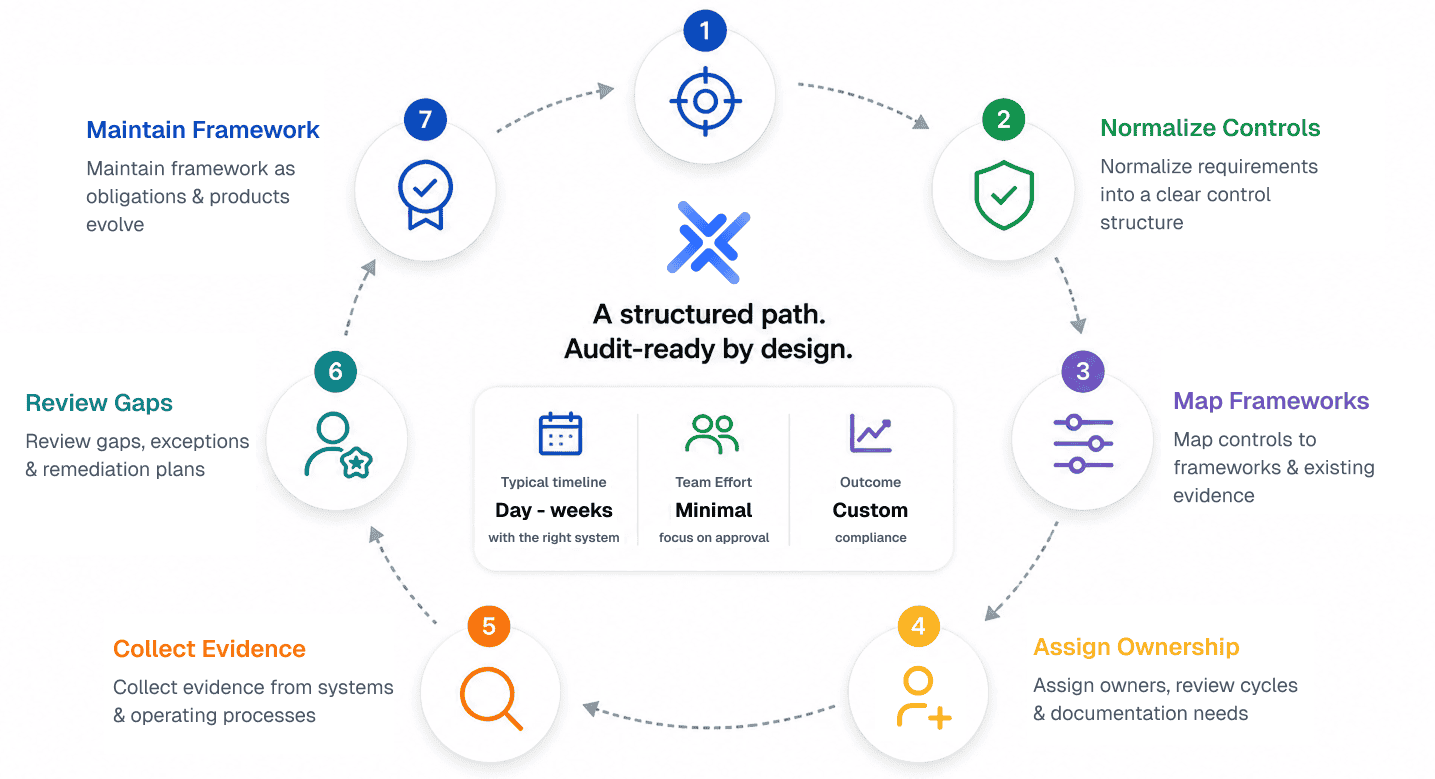
Approach determines timeline, internal effort, and long-term maintainability.
| Approach | Timeline | Cost | Internal Effort |
|---|---|---|---|
| Self-managed | 2-6+ months | Lower cash cost, higher hidden cost | High |
| Consultant-led | 1-4 months | Higher advisory cost | Medium |
| Using Ciphrix | Days to weeks for structure, ongoing as requirements evolve | Predictable platform cost | Lower, coordination-driven |
The efficiency comes from structuring requirements once and reusing controls, ownership, and evidence wherever possible.
Custom frameworks vary by organization. Not all requirements can be automated, and many depend on internal processes, reviews, or customer-specific expectations. What makes them manageable is structure, not just automation.
Step 01
Requirements are normalized into a consistent control structure across sources.
Step 02
Controls are mapped to owners, processes, and evidence regardless of source.
Step 03
Evidence is centralized and reused from integrations, documents, reviews, or manual inputs.
Step 04
Overlap is identified across customer requirements and frameworks to reduce duplicate work.
Step 05
Gaps, exceptions, and remediation are tracked continuously instead of at each request or audit.
Step 06
Ownership and review cadence stay clear even as requirements evolve.
For custom frameworks, Ciphrix provides a structured system to manage requirements, controls, evidence, and ownership so teams do not rebuild compliance for every customer or obligation.
Get a walkthrough of how teams convert customer, regulatory, and internal requirements into reusable controls and evidence.
Built by AWS Security Leaders | AWS Partner | Certified companies across 3 continents