

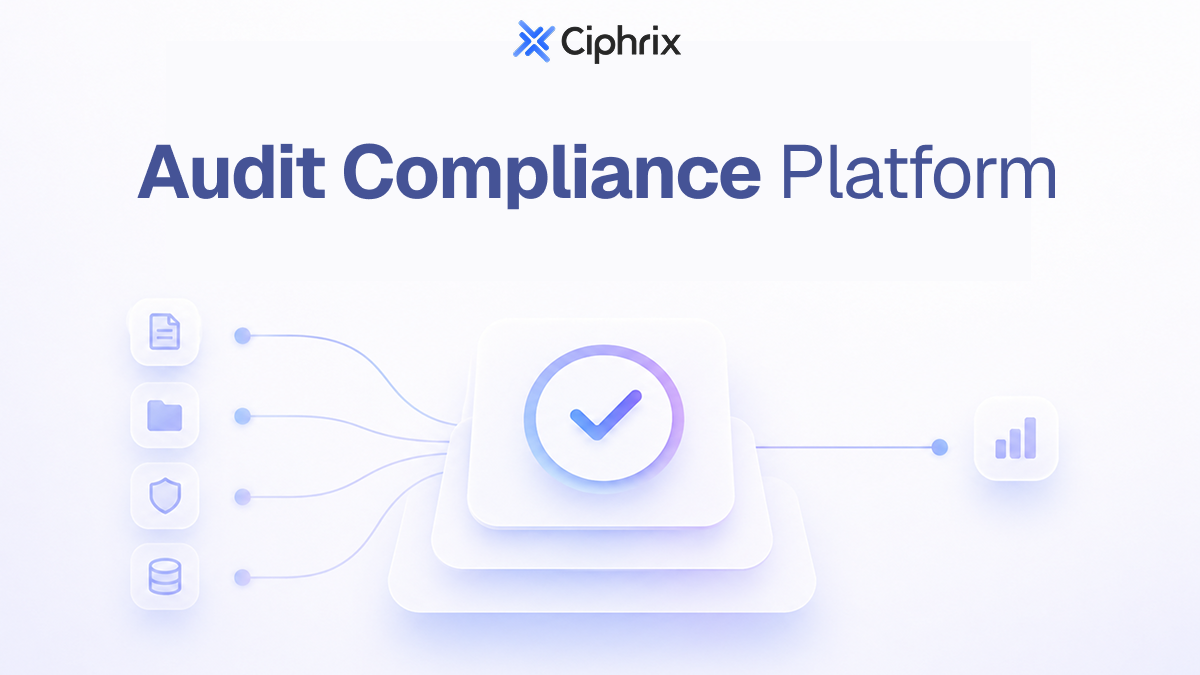
Compliance audits have a reputation for arriving like a storm. One quarter you're heads-down building product and closing deals, and the next you're buried in spreadsheet tabs, chasing engineers for screenshots, and wondering how a certification that was supposed to take six weeks has somehow consumed six months.
For fast-moving companies, this isn't just frustrating. It's a business problem. Enterprise buyers routinely require SOC 2 Type II or ISO 27001 certification before contracts can move forward, which means a slow or broken compliance process doesn't just cost time. It costs revenue.
That's the problem an audit readiness platform is built to solve. Rather than treating compliance as a seasonal scramble, these platforms turn audit readiness into a continuous, automated operational capability. By the time an auditor shows up, the evidence is already collected, the controls are already mapped, and your team hasn't had to drop everything to make it happen.
This article breaks down exactly what audit readiness platforms do, how they differ from traditional approaches, what separates good platforms from great ones, and how to know whether your organization is ready to make the switch.
The Old Way of Getting Audit-Ready (And Why It's Broken)
Picture the traditional compliance process. It usually starts with a spreadsheet. Someone on the team, often a security lead or an operations manager who already has a full plate, creates a master document listing every control your auditor expects to see evidence for. Then the emails start.
Engineering gets pinged for access logs. DevOps is asked to export configuration screenshots. HR needs to confirm onboarding records. Every request goes through an inbox, waits in a queue, and comes back in whatever format the recipient found convenient. By the time you've assembled everything, three weeks have passed and half the evidence is already outdated.
This is the manual compliance process, and it's the norm for organizations that haven't yet adopted a dedicated platform. It works, technically. Teams do get certified this way. But the cost is significant in ways that don't always show up on a budget line.
Diverted engineering time: Developers and infrastructure engineers are frequently pulled into compliance work that has nothing to do with their core responsibilities. Pulling audit logs, configuring monitoring tools, and responding to auditor questions can consume meaningful chunks of sprint capacity, particularly in the weeks leading up to an audit engagement.
Delayed certifications blocking sales: When a compliance timeline slips, it rarely stays contained to the compliance team. Enterprise deals that depend on a SOC 2 Type II certification don't close until that report exists. Every week of delay is a week of stalled revenue, and in competitive sales cycles, that delay can cost you the deal entirely.
Human error and audit gaps: Manual processes introduce inconsistency. Evidence collected at different times, by different people, in different formats creates gaps that auditors notice. A control that was technically in place might not be provable because no one captured the right evidence at the right moment. Remediating those gaps mid-audit is expensive and stressful.
The deeper issue is structural. Manual compliance processes were designed for a world where most companies pursued one certification, on one framework, every year or two. Modern enterprises operate in a different reality. They're pursuing SOC 2 and ISO 27001 simultaneously. They're adding HIPAA or GDPR compliance as they expand into new markets. They're expected to maintain continuous security posture, not just demonstrate it once a year.
Manual processes can't scale to meet that demand. Audit readiness platforms exist precisely because they can.
What an Audit Readiness Platform Actually Does
At its core, an audit readiness platform is a centralized system that continuously monitors your environment, automates evidence collection, and keeps your compliance posture current at all times, not just during the weeks before an auditor arrives.
The key word is "continuously." Traditional compliance is point-in-time. You gather evidence, you submit it, you get certified, and then you largely move on until the next cycle. An audit readiness platform replaces that cycle with an ongoing state of preparedness. Your controls are monitored in real time. Evidence is collected automatically as it's generated. If something drifts out of compliance, the platform flags it immediately rather than letting you discover it during fieldwork.
To understand how that works in practice, it helps to look at the core capability pillars these platforms are built around.
Automated evidence collection: Rather than manually requesting screenshots and logs from your engineering team, the platform connects directly to your cloud infrastructure, identity providers, code repositories, and other systems. It pulls evidence automatically, organizes it by control, and timestamps it for auditor review. The result is a continuously updated evidence library that's ready for inspection at any point in the audit cycle.
Policy management: Compliance frameworks require documented policies covering everything from access control to incident response. Managing these documents manually means tracking versions, ensuring approvals, and updating language whenever frameworks change. A dedicated platform centralizes policy creation and review workflows, so your policies are always current and traceable.
Control mapping: Every compliance framework defines a set of controls your organization must implement and demonstrate. An audit readiness platform maps those controls to your actual environment, showing which controls are satisfied, which have gaps, and what evidence exists for each. This gives your team a real-time view of compliance posture rather than a snapshot that's already stale by the time it's assembled.
Risk assessment: Compliance isn't just about checking boxes. It requires identifying, documenting, and managing risks across your organization. Platforms built for audit readiness include structured risk assessment workflows that connect directly to your control environment, so risk findings translate into actionable remediation tasks rather than sitting in a separate document no one reads.
Auditor collaboration workflows: One of the most friction-heavy parts of any audit is the back-and-forth between your team and the auditors reviewing your evidence. A purpose-built platform provides auditors with structured access to your evidence library, reducing the volume of requests, clarifying what's been submitted, and shortening the overall review cycle.
The distinction that matters most is the difference between a tool that helps you prepare for an audit and a platform that keeps you perpetually audit-ready. The former requires effort every time an audit approaches. The latter makes audit readiness a default state your organization maintains automatically.
How AI Agents Are Redefining What's Possible
Automation has been part of compliance tooling for years. Scheduled reminders, control checklists, and integration-based log collection are all forms of automation that older platforms have offered. But there's a meaningful difference between automation that notifies you to take action and AI agents that take action on your behalf.
Next-generation audit readiness platforms, including Ciphrix, are built around AI agents that actively perform compliance work rather than simply organizing tasks for humans to complete. This distinction matters more than it might initially seem.
Think of passive automation as a well-organized to-do list. It tracks what needs to happen, reminds you when deadlines are approaching, and stores the results when you submit them. Useful, but still fundamentally dependent on human effort at every step.
AI agents operate differently. They don't just track the task. They execute it. When a new control requires a policy document, an AI agent can draft that policy based on your existing environment and the framework's requirements. When evidence needs to be gathered from an integrated system, the agent retrieves it, maps it to the relevant control, and flags any gaps it identifies. When your control environment changes because you've onboarded a new vendor or modified your infrastructure, the agent detects the change and updates your compliance posture accordingly.
This shift from passive to active has compounding effects on certification timelines. The traditional compliance process involves significant back-and-forth: your team gathers evidence, submits it, receives questions from auditors, gathers more evidence, and repeats. Each cycle adds time. AI agents compress this loop by reducing the number of gaps that reach the auditor in the first place. Evidence is more complete, policies are more consistent, and control mappings are more accurate before the auditor ever logs in.
The practical result is that certification timelines that previously stretched over many months can compress to weeks. Not because corners are cut, but because the manual coordination work that consumed most of that time has been automated away.
This capability extends across frameworks. An AI agent working on SOC 2 compliance isn't limited to SOC 2. The same agent can simultaneously map evidence to ISO 27001 controls alongside SOC 2, flag HIPAA-relevant gaps, and track GDPR requirements. The work happens in parallel rather than sequentially, which is simply not possible when compliance depends on human effort alone.
For technically literate teams, the AI agent model also reduces the compliance expertise burden. You don't need a dedicated GRC specialist to interpret framework requirements and translate them into operational tasks. The platform does that translation, surfaces what needs attention, and executes what it can automatically. Your team focuses on decisions, not on logistics.
Multi-Framework Coverage: One Platform, Many Certifications
Here's a scenario that's increasingly common for growth-stage companies: you've completed your SOC 2 Type I and you're working toward Type II. At the same time, a major enterprise prospect in Europe is requiring ISO 27001 certification before they'll sign. Meanwhile, your product roadmap includes healthcare customers, which means HIPAA is on the horizon.
If you're managing each of these frameworks separately, whether through different tools or manual processes, you're duplicating a significant amount of work. And most of that duplication is unnecessary.
Compliance frameworks share a substantial amount of common ground. Access control requirements appear in SOC 2, ISO 27001, HIPAA, and GDPR. Incident response procedures are relevant across multiple frameworks. Vendor management controls show up in nearly every enterprise-grade certification. When you collect evidence for one framework, much of that evidence satisfies requirements in others.
The challenge is that without a unified platform, this overlap is invisible. Your team collects access control evidence for SOC 2, then collects it again for ISO 27001, then collects it a third time for HIPAA compliance requirements. Each collection effort takes time, and each represents work that didn't need to happen.
A purpose-built audit readiness platform maps shared controls across frameworks from the start. Evidence collected once is automatically applied to every framework where it's relevant. Your team sees a unified view of compliance posture across all active certifications, and gaps are identified at the control level rather than the framework level. Fix a gap once, and it's resolved everywhere it applies.
This unified approach also simplifies the auditor experience. Rather than maintaining separate evidence libraries for each certification, your team maintains one organized repository that auditors for any framework can access through structured workflows. The result is less coordination overhead and faster review cycles regardless of which certification is being assessed.
For companies pursuing multiple certifications simultaneously, or planning to expand their compliance program as they grow into new markets or customer segments, this multi-framework efficiency isn't a convenience. It's a core part of what makes an audit readiness platform worth the investment.
What to Look for When Evaluating an Audit Readiness Platform
Not all audit readiness platforms are built the same way, and the differences matter significantly depending on your organization's tech stack, growth trajectory, and compliance goals. Here are the criteria that separate platforms worth considering from those that will create new problems while solving old ones.
Integration depth: This is the most important technical criterion. A platform that can't connect to your actual infrastructure can't automate evidence collection in any meaningful way. Look for native integrations with cloud providers and identity tools your organization actually uses. Shallow integrations that only pull surface-level data will leave significant evidence gaps that your team has to fill manually, which defeats the purpose. The question to ask any platform vendor is not "do you integrate with AWS?" but "what specific evidence do you pull from AWS, and how is it mapped to controls?"
Auditor and partner experience: A compliance platform that's optimized for your internal team but creates friction for auditors will slow down your certification timeline rather than accelerate it. Look for platforms that provide structured auditor access, clear evidence organization, and workflows designed to minimize back-and-forth during fieldwork. Platforms that have established relationships with audit firms and understand how auditors actually review evidence tend to produce faster, smoother certification cycles.
Scalability and framework flexibility: Your compliance program today is not your compliance program in two years. As your organization grows, enters new markets, and responds to evolving regulatory requirements, your platform needs to grow with you. Look for multi-framework support including custom frameworks, which becomes relevant as enterprise customers begin requesting bespoke security assessments alongside standard certifications.
AI capability depth: Given how significantly AI agents can compress compliance timelines, it's worth evaluating how deeply AI is integrated into the platform's core workflows. There's a meaningful difference between a platform that uses AI to generate reports and one where AI agents actively perform policy drafting, gap analysis, and evidence mapping. Ask specifically what tasks AI agents handle autonomously versus what still requires manual input.
Time-to-value: Implementation complexity varies widely across platforms. Some require months of configuration before they deliver meaningful value. Others are designed to connect to your environment quickly and begin surfacing compliance posture within days. For fast-moving teams, time-to-value is a real consideration, not just a sales talking point.
Putting It All Together: Is an Audit Readiness Platform Right for You?
The honest answer is that not every organization needs an audit readiness platform right now. But the profile of teams that benefit most is broader than many people assume.
If your company is growing quickly, pursuing multiple certifications, operating with limited compliance headcount, or consistently finding that compliance work diverts engineering resources from product development, an audit readiness platform is likely a net positive. The same is true if compliance timelines have delayed deals or if you're anticipating expanding into regulated markets in the near future.
The most common objections are worth addressing directly.
Cost concerns: The ROI framing matters here. The relevant comparison isn't platform cost versus zero. It's platform cost versus the fully loaded cost of manual compliance: engineering hours diverted, compliance personnel time, auditor engagement fees, and the revenue impact of delayed certifications. When you add those up honestly, the platform cost tends to look different.
Complexity concerns: Modern audit readiness platforms are designed for technically literate generalists, not compliance specialists. Ciphrix, for example, is built so that a head of security or an engineering lead can manage the compliance program without needing deep GRC expertise. The platform handles framework interpretation and control mapping. Your team handles decisions and oversight.
Timing concerns: Some teams delay platform adoption because they feel their compliance program isn't mature enough to benefit. This is usually backwards. The earlier you adopt a structured platform, the less technical debt and evidence backlog you accumulate. Starting clean is significantly easier than retrofitting a platform onto years of manual processes.
Looking forward, the direction of travel is clear. Enterprise buyers are requiring more certifications, not fewer. Regulatory requirements are expanding across industries and geographies. The organizations that treat audit readiness as a continuous operational capability rather than a periodic project will have a structural advantage in sales cycles, customer trust, and regulatory resilience.
Audit readiness platforms aren't just a compliance tool. They're increasingly a competitive one.