
The buyer questions that reveal whether a compliance platform will reduce work—or merely organise it
Use this scorecard in every vendor demo. It compares capabilities and operating fit, not marketing promises. Score each category 1–5, require a live demonstration and record what the product actually did.
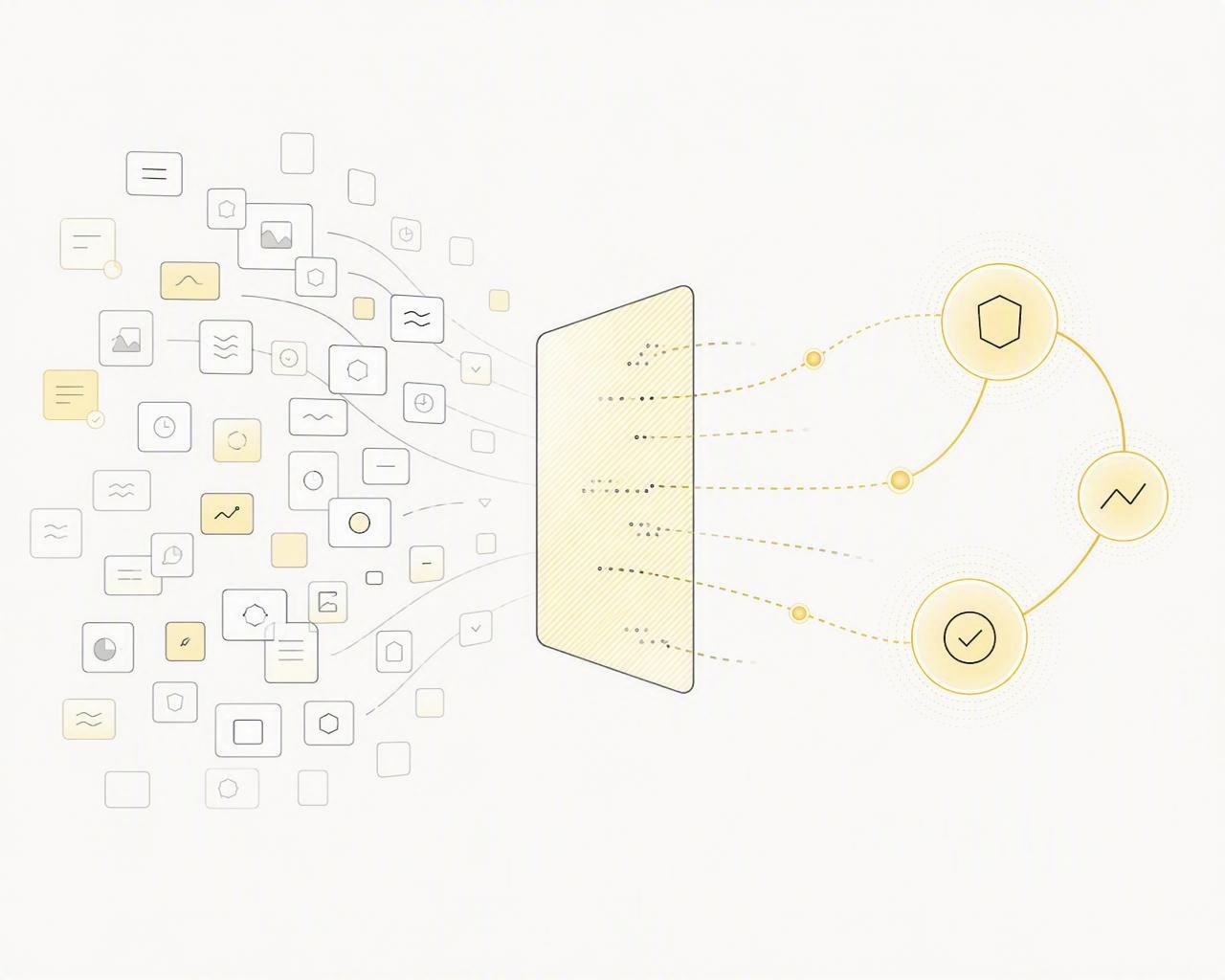
The test is simple: a credible platform should show these objects connected in the live workspace, rather than show a collection of framework labels or static dashboards.
Scoring guide
| Score | Meaning |
|---|---|
| 1 — not demonstrated | The answer is a claim, slide or roadmap; the vendor cannot show the work in a live environment. |
| 2 — partial | A feature exists, but key work still depends on exports, disconnected tools or manual reconstruction. |
| 3 — usable | The workflow works for the demonstrated case, with clear limitations recorded. |
| 4 — strong | The workflow is connected to source context, review and exceptions, and works beyond a happy-path example. |
| 5 — proven fit | The vendor demonstrates it against your actual scope or realistic data, including ownership and an exception path. |
| Category | What to ask for live | Score 1–5 |
|---|---|---|
| Real execution | Show the platform performing a concrete task: policy draft, evidence collection, risk assessment or questionnaire response. What still becomes manual work? | |
| Company context | How does the platform maintain context across systems, policies, risks, controls, owners and prior decisions? | |
| Evidence provenance | Show source, timestamp, scope, control mapping, review status and exception history for an artifact. | |
| Human accountability | Show who approves policy, accepts risk, approves evidence and releases a customer answer. | |
| Multi-framework reuse | Show one operating control mapped to multiple frameworks with scope-specific notes. | |
| Change and exceptions | Show stale evidence, failed control, remediation, risk acceptance and closure evidence. | |
| Customer assurance | Upload a questionnaire and show parsing, approved-answer matching, low-confidence routing, reviewer approval and export. | |
| Implementation support | Who maps your scope and operating reality into the platform, and what decisions remain with your team? |
Test evidence traceability, not just collection
Ask the vendor to follow one real item through this chain. A screenshot or an uploaded document is not sufficient evidence on its own: the reviewer should be able to see where it came from, which period it covers, what it supports, who reviewed it and what happens when it fails.
Red flags
- A “dashboard” is presented instead of a completed task.
- Evidence cannot be traced to a source, period and owner.
- The vendor claims AI can certify you, accept risk or remove review.
- Multi-framework coverage is a list of logos rather than a live mapped control.
- Questionnaire automation relies on an ungoverned library of old answers.
- Implementation assistance is vague or treated as an add-on after the sale.
Test automation claims under pressure
Ask the vendor to show the actual source connection, recurrence, exception route and traceable result. A feature can still be useful when it coordinates manual work; score it honestly as workflow tooling rather than as automation if people must initiate, reconstruct or chase the underlying evidence.
Test customer-assurance workflow separately
Questionnaire support is useful only when it preserves review and disclosure control. Ask to see a low-confidence answer routed to the right person, changed with rationale and approved before export.
Weighted decision sheet
| Category | Weight | Vendor score | Weighted result |
|---|---|---|---|
| Real execution and evidence provenance | 25% | ||
| Accountability, exceptions and audit trail | 20% | ||
| Company context and multi-framework reuse | 20% | ||
| Customer-assurance workflow | 15% | ||
| Implementation guidance and operating fit | 20% |
Decision rule: do not let a high score in a polished category outweigh a low score in evidence provenance, accountability or implementation fit. Those are the places where manual work and audit risk usually reappear.
Model the work that remains
Before you compare subscription prices, ask which teams will own integration setup, manual evidence, administration and remediation after launch. The lower licence price is not necessarily the lower operating cost when recurring work shifts back to engineering, control owners or external support.
Ciphrix-specific demo request
Ask Ciphrix to use your real scope and show how the workspace reaches 50% completion in 20 minutes. Then use the scorecard above to decide whether the demonstrated work is genuinely useful for your programme.
Book a demo to run that evaluation against your own systems, controls and operating model.
Source notes
This scorecard synthesises Ciphrix’s published compliance automation buying guide, compliance software buying guide, continuous evidence collection guide and AI agents overview. It is an evaluation framework, not a permanent unsourced comparison of named vendors.