

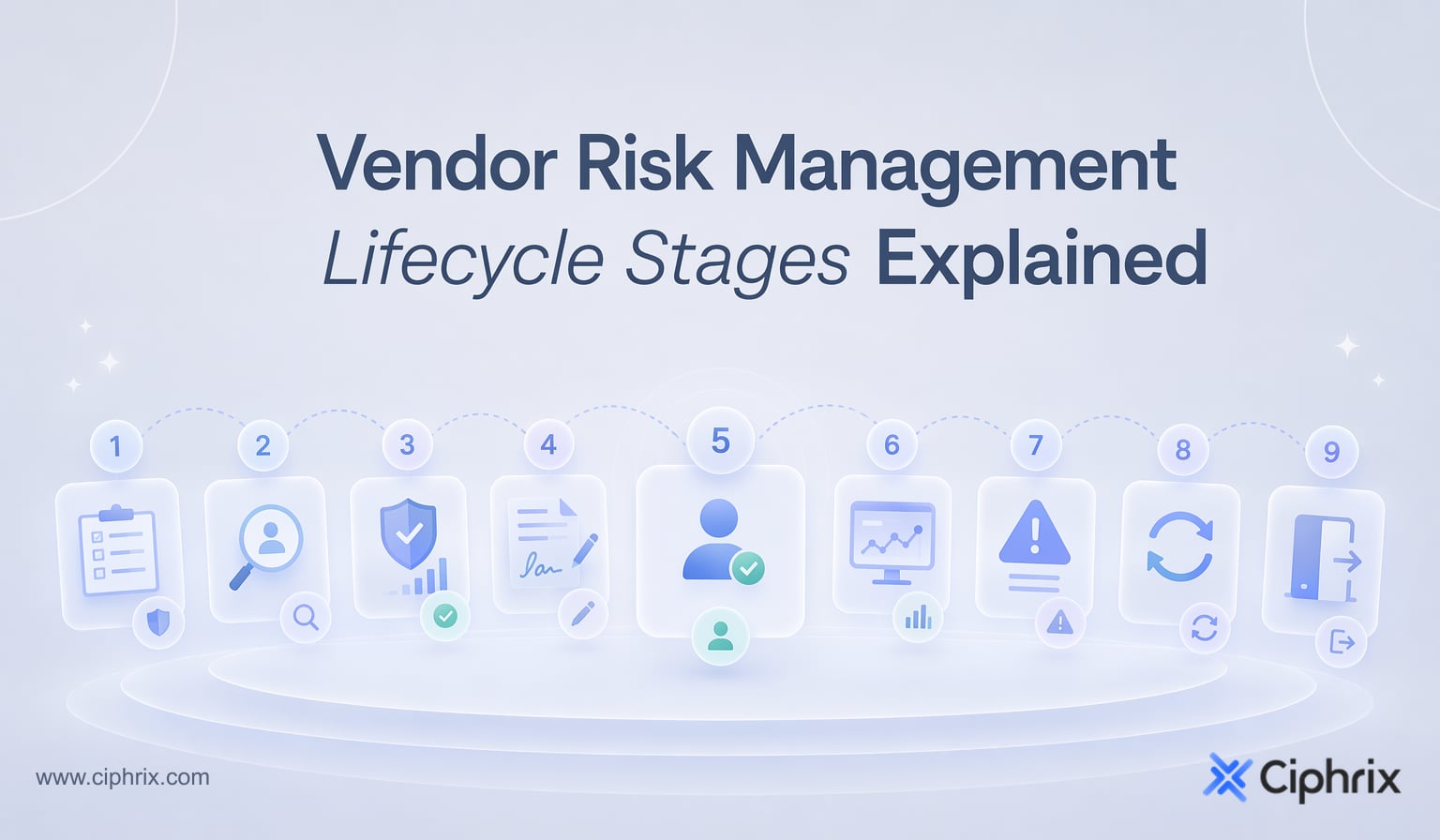
The vendor risk management lifecycle is the end-to-end process for identifying, assessing, approving, contracting, onboarding, monitoring, renewing, terminating, and offboarding vendors based on risk. Due diligence is only one gate in that lifecycle. Not the lifecycle itself. A vendor’s risk can change after approval because the service changes, access expands, controls fail, incidents occur, dependency grows, or the contract scope changes.
This article uses a nine-stage operating model. It is not an official standard or a universal scoring method. It is a practical way to make each stage produce a documented risk decision, supporting evidence, an owner, and a trigger for the next action.
What is the vendor risk management lifecycle?
Vendor risk management is risk-specific vendor governance. It is narrower than general procurement and broader than a one-time security questionnaire.
Regulatory and security guidance commonly treats third-party risk as a relationship lifecycle. For example, US banking agencies state that third-party risk management should cover planning, due diligence and selection, contract negotiation, ongoing monitoring, and termination across the relationship lifecycle (OCC). The UK National Cyber Security Centre similarly advises organisations to consider security throughout the supplier contract lifecycle: assessment level, due diligence, contractual controls, in-life security and incident management, and regaining control of assets and access at termination (NCSC).
The useful way to manage that lifecycle is through decision gates. In plain terms, it is a set of questions that stop the relationship from drifting along without anyone checking it properly:
- Should this vendor be reviewed?
- How much review is enough?
- Can the risk be accepted, reduced, transferred, or avoided?
- What controls must be contractual or operational?
- Has anything changed since approval?
- Should the relationship continue?
- Has access, data, and residual risk been closed out after exit?
The vendor risk management lifecycle at a glance
The stages below can be compressed for low-risk vendors and expanded for complex, high-risk, or critical vendors. The point is not to create bureaucracy; it is to make sure the depth of review matches the risk and criticality of the relationship. Interagency banking guidance supports proportional risk-management practices based on the organisation’s risk profile and the criticality of the third-party activity, while recognising that not all third-party relationships carry the same risk (OCC).
| Stage | Main decision | Evidence collected | Primary owner | Output | Next trigger |
|---|---|---|---|---|---|
| 1. Vendor identification and intake | Is there a valid business need to review this vendor? | Business need, requested service, vendor category, data involved, systems touched, business owner | Business owner | Complete vendor request | Risk triage required |
| 2. Initial risk triage and classification | How much review is required? | Inherent-risk factors such as data sensitivity, access, criticality, regulatory exposure, and dependency | Security/GRC or procurement, depending on model | Risk tier and due diligence scope | Due diligence begins |
| 3. Due diligence and risk assessment | Can the vendor meet the required risk and control expectations? | Questionnaires, policies, independent assessments, audit material, resilience evidence, testing summaries, remediation plans as relevant | Security/GRC | Risk assessment and recommendation | Contracting, escalation, or rejection |
| 4. Contracting and risk treatment | What obligations, controls, and remedies are needed? | Risk findings, required controls, negotiated terms, accepted residual risk | Legal with security/GRC and procurement | Contract terms, remediation plan, risk acceptance, or compensating controls | Approved onboarding |
| 5. Onboarding and access provisioning | Can the approved relationship operate safely? | Approved vendor record, access request, integration details, contacts, control confirmations, review cadence | IT and business owner | Access granted, monitoring schedule, owner assigned | Vendor goes live |
| 6. Ongoing monitoring and reassessment | Has risk changed since approval? | Updated evidence, change notices, incident signals, service changes, access reviews, performance reports | Security/GRC with business owner | Updated risk rating or escalation | Finding, incident, renewal, or material change |
| 7. Performance, issue, and incident management | What action is required when expectations are not met? | SLA issues, incident notices, unresolved findings, audit exceptions, remediation status | Business owner with security/GRC | Issue owner, remediation plan, escalation, or risk acceptance | Resolution, renewal review, or termination consideration |
| 8. Renewal, renegotiation, or termination decision | Should the relationship continue, change, or end? | Monitoring history, incidents, findings, dependency, performance, cost, alternatives | Business owner and procurement | Renewal approval, revised terms, exit plan, or termination | Renewal execution or offboarding |
| 9. Offboarding and post-termination verification | Has the relationship been closed safely? | Access removal proof, integration shutdown, data return or deletion confirmation, asset return, final record | IT with business owner | Offboarding evidence and closed risk record | Archive or residual-risk follow-up |
The nine vendor risk management lifecycle stages explained
1. Vendor identification and intake
Intake creates the first record of the proposed vendor relationship. It should capture enough information to decide whether risk review is needed before the organisation commits to the service.
The main risk question is: what will this vendor do, and what could it touch?
A practical intake record usually includes the business need, requested service, vendor category, expected users, data involved, systems or integrations touched, target start date, and named business owner. This is not a full assessment; it is the minimum context needed to route the vendor into the right review path.
The business owner normally initiates the request. Procurement may manage the intake workflow, while security, compliance, IT, finance, or legal are brought in based on the service. The output is a complete vendor request that can be triaged.
The next trigger is the need to classify inherent risk before deeper due diligence begins.
2. Initial risk triage and classification
Triage determines how much review the vendor needs before time is spent collecting detailed evidence. A low-risk office supplier and a critical cloud service provider should not go through the same process.
The main risk question is: how much risk could this relationship introduce before controls are considered?
Common triage factors include:
- sensitivity and volume of data involved;
- system, network, or production access;
- operational criticality;
- customer or employee impact;
- regulatory or contractual exposure;
- use of subcontractors;
- business dependency or difficulty of replacement.
The output is a risk tier, such as low, medium, high, or critical, plus the due diligence scope. This should not be treated as a universal formula. More accurately, it should not be treated as a formula that works without judgement. Each organisation should define tiering criteria appropriate to its risk profile and services.
The next trigger is a due diligence process scaled to the assigned tier.
3. Due diligence and risk assessment
Due diligence tests whether the vendor can meet the organisation’s security, privacy, compliance, resilience, and operational expectations for the proposed service.
The main risk question is: does the evidence support approval, rejection, escalation, or remediation?
Evidence should be selected according to the service, access, data, and criticality. It may include questionnaires, security policies, independent assurance reports, audit material, penetration test or vulnerability assessment summaries, business-continuity testing, service-management reporting, insurance evidence, or remediation plans where relevant. FFIEC business-continuity guidance, for example, recognises that periodic third-party assessment can draw on business-continuity testing, independent or third-party assessments, audit material, penetration tests, vulnerability assessments, and service-management reporting for relevant third parties (FFIEC).
No single artifact proves that a vendor is secure. The assessment should identify findings, judge residual risk, and recommend one of several decisions: approve, approve with conditions, escalate for risk acceptance, require remediation, reduce scope, or reject.
The next trigger is contracting and risk treatment for vendors that remain viable after assessment.
4. Contracting and risk treatment
Contracting translates risk findings into obligations, controls, and recourse. This stage is separate from due diligence: assessment identifies risk; contracting decides how the relationship will allocate and manage it.
The main risk question is: what must be contractually or operationally required before the vendor can be used?
Depending on the service, contract treatment may address security obligations, data handling, incident notification, audit or assurance rights, subcontractor expectations, service levels, remediation commitments, business-continuity obligations, exit assistance, and termination rights. The NCSC advises that supplier selection should assess whether the supplier can meet required security controls, use that assessment in the selection decision, and include necessary controls in the contract (NCSC).
The primary owner is usually legal, supported by security/GRC, procurement, compliance, IT, and the business owner. The output is signed terms, a remediation plan, accepted residual risk, compensating controls, or a decision not to proceed.
Contracts do not eliminate vendor risk. They define obligations, evidence rights, escalation paths, and exit options.
5. Onboarding and access provisioning
Onboarding makes the approved relationship operational. This is where contractual and risk decisions become actual controls, records, access, integrations, and responsibilities.
The main risk question is: are the approved controls in place before the vendor begins work or receives access?
Evidence may include the approved vendor record, assigned business owner, support and escalation contacts, access requests, integration documentation, control confirmations, monitoring schedule, and any pre-go-live remediation items. IT usually manages access and integrations. The business owner confirms operational readiness. Security or compliance may verify that required control conditions are complete.
The output is an active vendor record, approved access, defined monitoring cadence, and clear ownership for the relationship.
The next trigger is go-live, after which the risk must be monitored rather than assumed static.
6. Ongoing monitoring and reassessment
Monitoring detects whether the vendor’s risk has changed after approval. It should cover both scheduled reassessment and event-driven review.
The main risk question is: does the current evidence still support the approved risk decision?
Monitoring may include updated assurance evidence, control attestations, service changes, access changes, incidents, unresolved findings, SLA performance, ownership changes, subcontractor changes, or changes in data volume, data type, or technology. The NCSC advises organisations to monitor whether supplier security provisions remain effective, manage incidents appropriately, and define how findings outside agreed thresholds will be handled. It also cautions that external continuous-monitoring tools may flag significant changes but do not provide a precise test of a supplier’s capabilities (NCSC).
The output is an updated risk rating, accepted risk, remediation request, escalation, or input into renewal. Monitoring should have defined triggers, such as material service changes, new access, significant incidents, repeated performance failures, or upcoming renewal.
7. Performance, issue, and incident management
Issue management is the response mechanism when monitoring, operations, or the vendor itself identifies a problem. It is distinct from monitoring: monitoring detects change; issue management decides what to do about it.
The main risk question is: does this problem require remediation, escalation, risk acceptance, scope reduction, or termination consideration?
Relevant evidence may include missed service levels, incident notifications, security events, audit exceptions, overdue remediation, failed control evidence, customer impact, and vendor response records. The issue should have an owner, target resolution, severity, escalation criteria, and decision authority appropriate to the vendor’s risk and criticality.
The output is a remediation plan, escalation decision, risk acceptance, compensating control, or termination consideration.
The next trigger is either resolution, continued monitoring, or a renewal/termination decision if the issue changes the business case for the relationship.
8. Renewal, renegotiation, or termination decision
Renewal is a decision gate, not an administrative extension. It should use the evidence accumulated during the relationship.
The main risk question is: does the organisation still want this vendor under the same scope, terms, and risk conditions?
The review should consider current risk tier, unresolved findings, incidents, performance, business dependency, cost, service changes, access changes, alternatives, and whether existing contract terms still match the risk. The decision may be to renew, renew with added controls, renegotiate terms, reduce scope, obtain formal risk acceptance, create an exit plan, or terminate.
The business owner should not make this decision in isolation when risk is material. Procurement, legal, security/GRC, compliance, finance, and IT may all need to contribute depending on the vendor’s role.
The next trigger is either renewal execution or controlled offboarding.
9. Offboarding and post-termination verification
Termination is the decision to end the relationship. Offboarding is the controlled execution of that decision.
The main risk question is: has the organisation regained control of access, data, assets, integrations, and records?
Offboarding evidence may include access removal proof, disabled accounts, terminated integrations, returned assets, data return or deletion confirmation, transition records, final invoices, retained records, and documented residual risk. The NCSC’s supplier assurance guidance says supplier arrangements should consider secure return or deletion of data and assets at contract exit, transfer to a replacement supplier where relevant, and controls for changes in the supplier’s information-risk profile over time (NCSC).
IT usually handles technical access and integrations. The business owner confirms the service has ended or transitioned. Legal and compliance may advise on records, contract obligations, and data handling where relevant.
The output is offboarding evidence and a closed vendor risk record, with any residual risk documented for follow-up.
Who owns each stage of the vendor risk management lifecycle?
Vendor risk management depends on handoffs. No single team owns every decision because the risk spans business need, commercial process, security, legal terms, compliance obligations, finance, and technical access.
The matrix below is an illustrative operating model, not a universal RACI. Adapt it to your organisation’s structure and approval model.
| Lifecycle activity | Business owner | Procurement | Security/GRC | Legal | Compliance | Finance | IT |
|---|---|---|---|---|---|---|---|
| Vendor intake | A/R | R | C | I | C | C | C |
| Risk triage | C | R | A/R | C | C | I | C |
| Due diligence | C | C | A/R | C | C | I | C |
| Contract risk treatment | C | R | C | A/R | C | C | C |
| Onboarding and access | A | C | C | I | C | I | R |
| Ongoing monitoring | R | C | A/R | I | C | I | C |
| Issue and incident response | A/R | C | R | C | C | C | R |
| Renewal or termination decision | A/R | R | C | C | C | C | C |
| Offboarding verification | A | C | C | C | C | C | R |
Key: A = accountable, R = responsible, C = consulted, I = informed.
The most important thing is not the exact letter in each cell. It is making sure each decision gate has one accountable owner, clear contributors, and a documented output.
How vendor risk tier changes the lifecycle
Risk tier should change the depth of review, not the existence of the lifecycle, even a low-risk vendor should have a record, owner, and exit path. A critical vendor needs stronger evidence and tighter governance because failure, compromise, or service disruption would have greater impact.
A proportionate approach may look like this:
- Low-risk vendors: basic intake, lightweight triage, limited evidence, standard terms, and simple offboarding confirmation.
- Medium-risk vendors: targeted due diligence, review of relevant controls, defined monitoring triggers, and renewal review based on performance and changes.
- High-risk or critical vendors: deeper evidence, security and legal review, clearer contractual controls, defined escalation paths, closer monitoring, renewal scrutiny, and stronger proof at offboarding.
Tiering should influence:
- due diligence depth;
- contract requirements;
- access and integration controls;
- monitoring and reassessment triggers;
- escalation thresholds;
- residual-risk approval;
- renewal scrutiny;
- offboarding evidence.
Avoid treating the tier as permanent. A vendor can become higher risk if it receives more data, gains privileged access, supports a critical process, changes subcontractors, suffers a material incident, or becomes harder to replace.
Common mistakes that break the vendor risk management lifecycle
The lifecycle usually fails when stages are skipped or blurred. Common failure points include:
- Treating due diligence as the whole process. Approval only establishes the starting risk position.
- Approving vendors without a business owner. No one is accountable for relationship changes, issues, or renewal decisions.
- Collecting evidence without making a decision. A questionnaire is not useful, not really useful, unless it leads to approval, remediation, escalation, rejection, or risk acceptance.
- Failing to convert findings into controls. Material findings should influence contract terms, operational controls, or scope.
- Granting access before onboarding is complete. Access should follow approval conditions, not precede them.
- Monitoring without escalation criteria. Findings outside agreed thresholds need a defined response path.
- Renewing without reviewing accumulated evidence. Incidents, unresolved findings, performance, and dependency should inform renewal.
- Terminating without verified offboarding. Ending the contract does not by itself remove access, recover data, or close residual risk.
How to make vendor risk management operational
A lifecycle only works when vendor records, evidence, owners, controls, findings, review triggers, renewal decisions, and offboarding proof stay connected. Otherwise, each renewal or incident becomes a document scramble.
The practical operating model is simple:
- Capture every vendor relationship through intake.
- Classify risk before deep review.
- Collect evidence matched to service, access, data, and criticality.
- Turn findings into decisions, controls, contract terms, or escalations.
- Monitor for change after approval.
- Use accumulated evidence at renewal.
- Verify access, data, and records at exit.
Ciphrix supports this operating-system view of compliance and risk: continuous evidence, reusable controls, clear ownership, and workflow-driven review. Whether run in a dedicated platform or internal process, the goal is the same: every lifecycle stage should leave behind a decision, evidence, an owner, and usually a next action.