

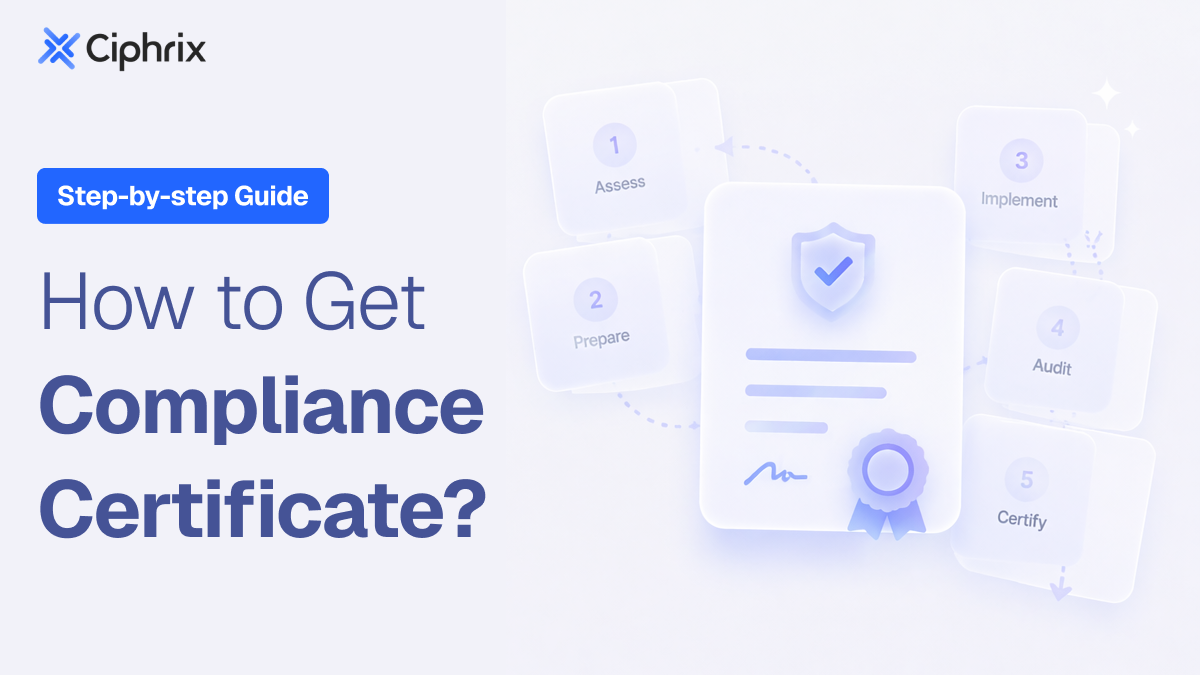
For SaaS companies, compliance certification has shifted from a nice-to-have to a genuine growth requirement. Enterprise buyers run security questionnaires before signing contracts. Procurement teams block deals without a SOC 2 report. Expansion into regulated industries like healthcare or finance requires demonstrable proof of controls.
Yet most SaaS teams approach certification the same way: scrambling, over-relying on spreadsheets, and burning months of engineering time on manual evidence collection. The result is a process that feels like a second full-time job.
This guide changes that. Whether you're pursuing SOC 2 Type II, ISO 27001, HIPAA, or multiple frameworks simultaneously, the steps here reflect how modern, fast-moving SaaS companies actually achieve audit-ready status without grinding operations to a halt.
You'll learn how to scope your certification correctly from day one, build the right controls infrastructure, automate evidence collection, and work with auditors efficiently so you cross the finish line in weeks, not months. Each step is designed to be actionable with clear inputs and outputs, so your team always knows what comes next.
By the end, you'll have a repeatable compliance program, not a one-time certificate that expires and leaves you starting over.
Step 1: Choose the Right Framework (or Frameworks) for Your Business
Before you write a single policy or configure a single integration, you need to answer one foundational question: what's actually driving the need for certification? The answer shapes every decision that follows.
The most common drivers are customer demand, enterprise deal requirements, regulatory obligations, and market expansion goals. Each points toward a different framework, and picking the wrong one means spending months building toward a certificate your customers don't care about.
Here's how the major frameworks map to their use cases:
SOC 2: The dominant compliance certification for SaaS companies selling into the US enterprise market. If your sales team is losing deals because prospects are asking for a security report, SOC 2 is almost certainly the right starting point.
ISO 27001: The internationally recognized information security management standard. Required or strongly preferred by EU, UK, APAC, and Middle Eastern enterprise customers. If you're expanding globally or selling to large multinationals, ISO 27001 certification opens doors that SOC 2 alone cannot.
HIPAA: Applies to any SaaS company that creates, receives, maintains, or transmits Protected Health Information (PHI) on behalf of covered entities. If you're building in the healthcare space, this is a regulatory requirement, not an optional credential.
GDPR and DPDP: GDPR applies to any company processing personal data of EU residents, regardless of where the company is headquartered. India's Digital Personal Data Protection (DPDP) Act creates parallel obligations for companies processing Indian citizens' data. These are legal requirements, not certifications, but they inform your controls architecture significantly.
One of the most important strategic decisions here is identifying framework overlap early. SOC 2 Trust Service Criteria and ISO 27001 Annex A controls share significant common ground, particularly in access control, change management, incident response, and availability. Pursuing both frameworks simultaneously with a shared controls approach is substantially more efficient than pursuing them sequentially.
The most common pitfall at this stage is choosing a framework based on what a single prospect asked for, rather than what your full customer base will require in the next 12 to 18 months. Think ahead. If you're closing your first enterprise deal with a US company today but plan to expand into Europe next year, building toward both SOC 2 and ISO 27001 from the start saves significant rework later. See our detailed breakdown of ISO 27001 vs SOC 2 to help inform that decision.
Output from this step: A documented framework selection decision with a clear business justification, identifying which frameworks you're pursuing, in what order, and why.
Step 2: Define Your Scope and Identify What's In Play
Scoping is the most consequential decision in the entire compliance certification process. A scope that's too broad creates unnecessary work and inflates audit costs. A scope that's too narrow creates audit risk and can undermine the credibility of your report with sophisticated buyers.
Start by defining your system boundary: which products, environments, infrastructure components, and data types are in scope. For most SaaS companies, this means identifying your production environment, the specific services that process customer data, and the team members who operate and maintain those systems.
Next, map all third-party vendors and cloud services that touch in-scope data. AWS, GCP, Azure, identity providers, payment processors, monitoring tools, and support platforms all become part of your vendor risk program once they're in scope. This isn't just a compliance exercise; it's a genuine risk management activity that auditors will examine closely.
Data flow mapping is critical here. Where does customer data enter your system? Where does it live? Where does it exit? This mapping drives your control selection and helps you identify where your most significant risk exposure sits.
For HIPAA specifically, you need to identify every PHI touchpoint in your system and determine which third-party vendors require Business Associate Agreements (BAAs). Missing a BAA with a vendor who touches PHI is a significant audit finding. Review the full scope of HIPAA compliance requirements to ensure no touchpoints are overlooked.
Regional considerations matter too. For companies with EU customers, GDPR scoping overlaps meaningfully with ISO 27001 Annex A controls, so your scope definition can do double duty. Indian companies should simultaneously consider DPDP Act obligations when mapping personal data flows.
A practical tip: when in doubt about whether something is in scope, err toward inclusion during scoping and then make a deliberate, documented decision to exclude it if appropriate. Auditors are more comfortable with a well-reasoned exclusion than with discovering something was quietly left out.
Output from this step: A written scope statement and a system description document. The system description is a required deliverable for SOC 2 audits and a useful reference document for every other framework you pursue.
Step 3: Conduct a Gap Assessment Against Your Target Framework
A gap assessment maps your current state against the controls your chosen framework requires. Think of it as an honest inventory: what do you already have, what are you missing, and what needs to be built or improved before an auditor shows up?
To run a gap assessment, work through each control domain systematically. For SOC 2, this means reviewing the Trust Service Criteria across security, availability, processing integrity, confidentiality, and privacy. For ISO 27001, you're working through the Annex A control set. For each domain, rate your current maturity honestly: implemented and documented, partially implemented, or not yet addressed.
Not all gaps are equal, and prioritization matters. Auditors focus heavily on certain control areas, particularly access control, encryption, and incident response. A gap in your formal vendor reassessment cadence is less urgent than the absence of MFA enforcement on production systems. Prioritize by both risk level and audit likelihood.
Common gaps for early-stage SaaS companies include:
No formal vendor risk process: Many teams use dozens of SaaS tools without any documented process for evaluating their security posture or reviewing them on a recurring basis.
Missing security awareness training records: Training may happen informally, but auditors need documented evidence that every employee completed it, with timestamps.
Undocumented change management procedures: Engineering teams often have effective practices for deploying code changes, but those practices aren't written down or consistently followed in a way that produces audit evidence.
Insufficient access review cadence: Quarterly access reviews are a standard expectation. Many companies do ad hoc reviews but can't demonstrate a consistent, recurring process.
AI-powered compliance platforms can significantly accelerate this stage by auto-mapping your existing infrastructure to control requirements, flagging gaps automatically rather than requiring manual review of each control domain. Ciphrix's AI agents for compliance are purpose-built for exactly this kind of automated gap detection.
Output from this step: A prioritized gap register with a control owner assigned to each item and a remediation timeline. This document becomes your project plan for Step 4.
Step 4: Build and Implement Your Controls and Policies
Controls are what you actually do to manage risk. Policies are what you've formally committed to doing. You need both, and they need to match each other.
Start with technical controls before writing policies. Implement MFA enforcement across all systems that access in-scope data. Configure encryption at rest and in transit. Set up centralized logging and monitoring. Establish your vulnerability management process. Once these controls are operating, you write policies that accurately describe them, not the other way around.
Every SaaS company pursuing compliance certification needs a core policy library that includes:
Information Security Policy: The overarching document that establishes your organization's commitment to information security and the governance structure that supports it.
Access Control Policy: Defines how access to systems and data is granted, reviewed, and revoked. Should align directly with your MFA and least-privilege technical controls.
Incident Response Plan: Documents how your team identifies, contains, and recovers from security incidents. Must include defined roles, escalation paths, and communication procedures.
Business Continuity and Disaster Recovery Plan: Addresses how you maintain operations and recover data in the event of a significant disruption.
Vendor Management Policy: Establishes how you evaluate, onboard, and periodically reassess third-party vendors who handle in-scope data.
Acceptable Use Policy: Sets expectations for how employees use company systems and data.
Assign a named control owner for every control in your controls matrix. Not a team, not a role title: a specific person. This is important because auditors will ask control owners to explain and demonstrate their controls during fieldwork. Ambiguous ownership creates delays and risk during the audit.
The most important warning at this stage: don't write policies that describe aspirational behavior you don't actually practice. Auditors test controls against evidence. If your Access Control Policy says access reviews happen monthly but your evidence shows they happened twice last year, that's an audit finding. Every policy should describe your actual operating environment. A structured compliance management platform helps ensure your documented policies stay aligned with your live controls.
Policy templates can accelerate drafting significantly, but every template must be reviewed and tailored to your actual environment before adoption. A policy that references systems you don't use or processes you haven't implemented is worse than no policy at all.
Output from this step: A complete policy library with version history and approval signatures, plus a controls matrix that maps each control to the relevant framework requirement.
Step 5: Automate Evidence Collection Before the Audit Clock Starts
Evidence collection is where manual compliance programs collapse. Gathering screenshots, access logs, training completion records, and configuration exports across dozens of systems is time-consuming, error-prone, and deeply tedious. It also scales poorly: the more your infrastructure grows, the worse the manual burden becomes.
Understanding what auditors actually want helps clarify why automation matters so much. For SOC 2 Type II, auditors need continuous, timestamped evidence that controls operated consistently throughout the entire observation period, which typically spans six to twelve months. A screenshot taken the week before the audit doesn't satisfy this requirement. Automated, ongoing evidence collection does.
The distinction between Type I and Type II is worth emphasizing here. SOC 2 Type I is a point-in-time snapshot: it assesses whether your controls are designed appropriately at a specific moment. SOC 2 Type II assesses whether those controls actually operated effectively over time. Type II is what enterprise buyers want, and automation is essentially required to produce it without burning out your team.
Connect your compliance platform to your existing infrastructure. Key integrations include:
Cloud providers (AWS, GCP, Azure): Automated collection of configuration snapshots, access logs, and security findings.
Identity providers (Okta, Azure AD): Automated evidence for access provisioning, deprovisioning, and MFA enforcement.
HR systems: Automated tracking of employee onboarding, offboarding, and security training completion.
Ticketing tools (Jira, ServiceNow): Evidence for change management and incident response procedures.
Endpoint management platforms: Automated verification of device compliance, encryption status, and software patching.
Once integrations are live, configure automated workflows for recurring evidence tasks: quarterly access reviews, vulnerability scan results, backup verification logs, and security training completion rates. These run on a schedule without manual intervention, building your evidence repository continuously. Explore the full range of compliance platform integrations to see which tools connect directly to your existing stack.
The timing principle here is simple: the earlier you connect integrations, the longer your evidence trail. Starting automation on day one of your observation period saves significant manual effort at audit time and gives you a stronger, more defensible evidence package.
Output from this step: A live evidence repository with automated collection workflows, organized by control and ready to share with your auditor.
Step 6: Select Your Auditor and Navigate the Audit Process
Choosing the right auditor is as important as the preparation work that precedes the audit. The wrong choice adds cost, delays, and friction at exactly the moment you want things to move quickly.
For SOC 2, only a licensed CPA firm can issue a SOC 2 report. Your compliance platform, however capable, is not your auditor. This is a common point of confusion for teams new to the process. The platform prepares you; the CPA firm certifies you.
For ISO 27001, certification is issued by an accredited Certification Body. Choose one accredited by a recognized national accreditation body: UKAS in the UK, JAB in Japan, NABCB in India, ANAB in the United States. Accreditation matters because some enterprise customers and government buyers specifically require certification from an accredited body.
When evaluating auditors, consider these factors:
SaaS industry experience: Auditors familiar with cloud-native architectures understand your environment and ask better questions. Auditors without this background may apply controls expectations designed for on-premise systems that don't fit your context.
Familiarity with your compliance platform: Auditors who work regularly with modern compliance platforms accept evidence packages more efficiently and have clearer expectations about format and completeness.
Turnaround time and pricing transparency: Get clear commitments on both before signing an engagement letter. Vague timelines and scope-based billing surprises are common sources of friction.
The audit workflow typically follows this sequence: a readiness assessment, fieldwork where the auditor reviews your evidence, a draft report review period where you can address findings, and final report issuance.
Prepare your team before fieldwork begins. Brief control owners on what to expect: auditors will ask them to explain their controls, walk through their evidence, and sometimes demonstrate processes live. Conduct an internal readiness review and resolve any open exceptions before the auditor starts.
Common audit delays include missing evidence for a specific control period, undocumented exceptions that surface during fieldwork, and control owners who are unavailable or unprepared during the review window. All three are preventable with proper preparation. See how other SaaS companies navigated their audits to understand what a well-prepared audit process looks like in practice.
A regional note for Australian SaaS companies selling to federal government: be aware of the IRAP (Information Security Registered Assessors Program) assessment framework administered by the Australian Cyber Security Centre (ACSC), which may be required in addition to ISO 27001 for certain government contracts.
Output from this step: A completed audit with a clean report, or a qualified report with documented exceptions, ready to share with customers and prospects.
Step 7: Maintain Continuous Compliance After Certification
Certification is not a finish line. It's an operating state. This distinction matters enormously for how you structure your program after the initial report is issued.
SOC 2 reports must be renewed annually. ISO 27001 requires annual surveillance audits and a full recertification every three years. If you treat certification as a one-time project, you'll find yourself scrambling every renewal cycle, rebuilding evidence repositories from scratch and revisiting gaps you thought were closed.
Build a compliance calendar that schedules recurring tasks so nothing falls through the cracks. Key recurring activities include quarterly access reviews, annual policy reviews with documented approval, vendor reassessments on a defined cycle, penetration tests on at least an annual basis, and security awareness training completion tracking.
Monitor for control drift. Infrastructure changes, new SaaS tool adoptions, employee onboarding and offboarding, and product updates can all introduce new risks or create evidence gaps. A control that was operating effectively six months ago may have drifted out of compliance due to an infrastructure migration or a team reorganization. Continuous monitoring catches this before your auditor does.
Use your compliance program as a sales asset. Make your SOC 2 report available through a trust portal so prospects can access it without a lengthy back-and-forth. Respond to security questionnaires faster by referencing your documented controls. Reduce sales cycle friction with enterprise buyers who would otherwise block deals pending security review.
As your program matures, adding additional frameworks becomes significantly more efficient. Once your core controls are in place for SOC 2, adding ISO 27001 requires far less incremental work because of the substantial control overlap between the two frameworks.
Output from this step: A continuous compliance program with automated monitoring, a recurring task calendar, and a trust portal for customer-facing transparency.
Frequently Asked Questions
How long does it take to get SOC 2 certified?
It depends on which type you're pursuing. SOC 2 Type I can be achieved in roughly six to ten weeks with thorough preparation and the right tooling. SOC 2 Type II requires a minimum observation period, commonly six months, during which your controls must be operating and generating evidence. With automation in place from day one of the observation period, the overall Type II timeline can be significantly compressed compared to manual approaches.
What's the difference between SOC 2 and ISO 27001?
SOC 2 is a US-originated attestation report issued by a CPA firm, focused on how a service organization manages customer data. ISO 27001 is an internationally recognized certification for an information security management system (ISMS), issued by an accredited Certification Body. Many SaaS companies pursue both, using SOC 2 for US enterprise sales and ISO 27001 for global and EU customer requirements.
Do we need a dedicated compliance team to get certified?
Not necessarily. Many SaaS companies achieve certification with a part-time compliance owner supported by automation tooling. The key is having clear control ownership across the team and a platform that reduces the manual burden of evidence collection and policy management.
How much does SOC 2 certification cost?
Costs vary significantly based on auditor selection, scope complexity, company size, and whether you use a compliance platform to prepare. Engaging an auditor directly without preparation tooling tends to be more expensive overall because of the additional time auditors spend gathering and organizing evidence. Getting multiple quotes and understanding what's included in each engagement is essential.
Can we pursue SOC 2 and ISO 27001 at the same time?
Yes, and it's often more efficient than pursuing them sequentially. A multi-framework compliance platform maps shared controls across both frameworks, reducing duplicate work and letting your team build once and satisfy requirements for both certifications simultaneously.
What happens if we fail an audit?
SOC 2 and ISO 27001 audits don't produce simple pass/fail outcomes. Auditors issue qualified opinions with documented exceptions when controls aren't operating as designed. Understanding how to respond to exceptions, whether by remediating the gap or providing context, is an important part of audit preparation. A qualified report with well-documented exceptions is still a usable report.
Is HIPAA a certification?
No. HIPAA compliance is a regulatory requirement, not a certification issued by a third party. There is no official HIPAA certificate. However, third-party HIPAA readiness assessments and audits are conducted by specialized firms and can serve as evidence of your compliance posture for healthcare customers and covered entities.
Your Compliance Certification Checklist
Here's the complete seven-step process in scannable form, ready to use as a working checklist for your team:
1. Choose your framework(s): Align certification goals with customer requirements, regulatory obligations, and market expansion plans. Document your decision with business justification.
2. Define your scope: Identify your system boundary, data flows, and third-party vendors. Produce a written scope statement and system description document.
3. Conduct a gap assessment: Map your current controls against framework requirements. Produce a prioritized gap register with assigned owners and remediation timelines.
4. Build controls and policies: Implement technical controls first, then write policies that accurately describe them. Assign named control owners and build your controls matrix.
5. Automate evidence collection: Connect your compliance platform to cloud providers, identity systems, HR tools, and ticketing platforms. Start automation at the beginning of your observation period.
6. Select your auditor and complete the audit: Choose an auditor with SaaS experience and platform familiarity. Prepare control owners, resolve open exceptions, and move through the audit workflow efficiently.
7. Maintain continuous compliance: Build a recurring task calendar, monitor for control drift, and use your certification as a trust asset in your sales process.
The biggest differentiator between companies that certify in weeks versus months isn't effort. It's automation and tooling. Teams that rely on manual processes spend the majority of their time gathering evidence and chasing down documentation. Teams that automate spend their time on the decisions that actually require human judgment.
Ciphrix's AI-powered compliance platform puts AI agents to work on the tasks that slow teams down most: policy management, evidence collection, risk assessment, and audit preparation across SOC 2, ISO 27001, HIPAA, and other major frameworks. The result is a compliance program that moves at the speed your business requires, without the operational drag of traditional approaches.
Compliance certification is a competitive advantage. It opens enterprise deals, accelerates procurement cycles, and builds the kind of trust that turns prospects into long-term customers. The seven steps above give you a repeatable, scalable path to get there and stay there. Learn more about our services and see how fast audit-ready status is achievable for your team.