

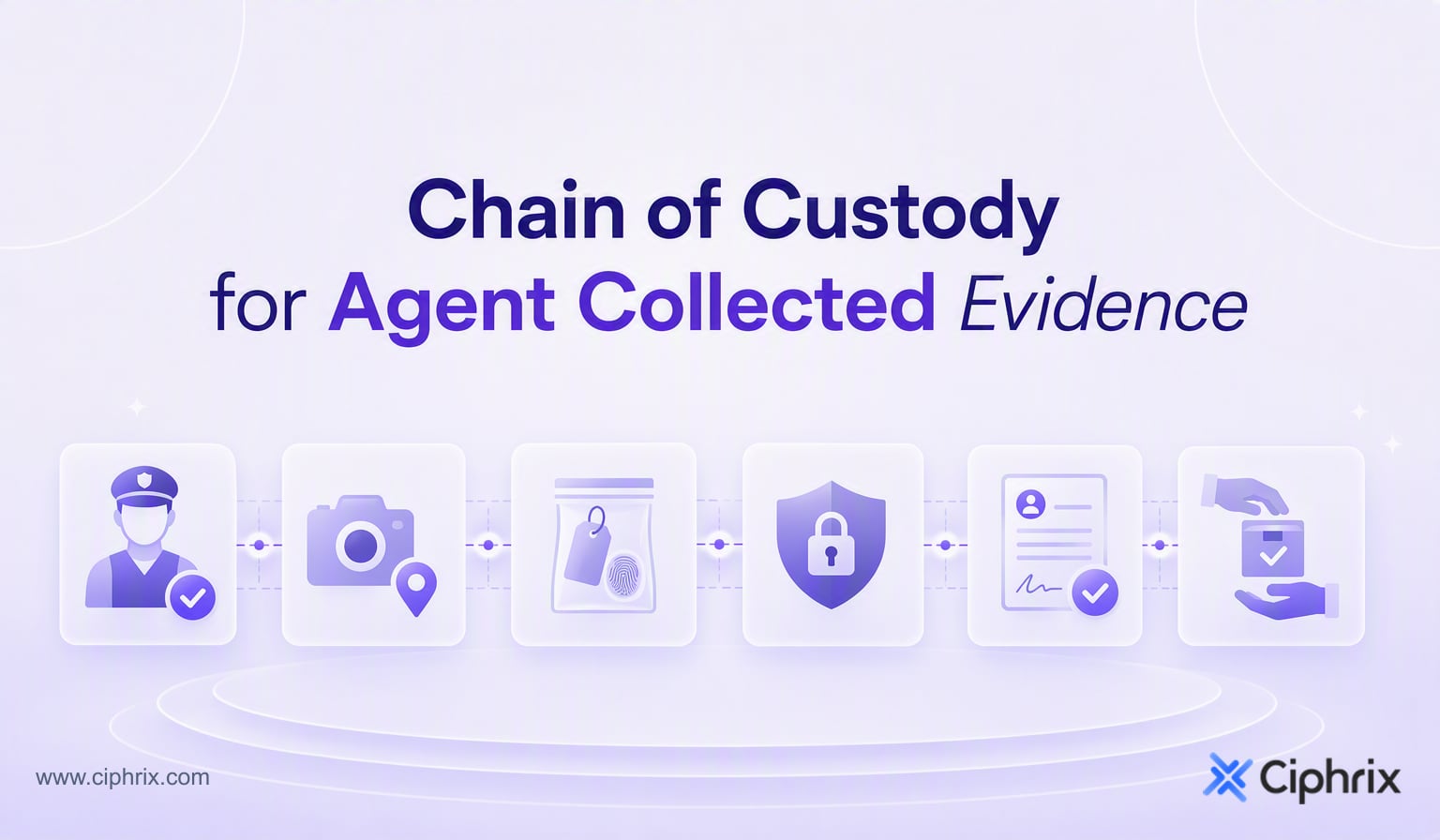
When evidence is first collected by an agent, the chain of custody must show more than the later custodian’s control. It must document who the agent was, why they were authorised or assigned to collect, what they collected, the condition and source of the item or record, how it was protected before transfer, and exactly how the recipient accepted it.
That first handoff is the critical control point. Right at the start. If collection authority, item identity, temporary storage, or transfer details are missing at the start, later custody records may look orderly while still leaving the most important gap unexplained.
What chain of custody means for agent-collected evidence
Chain of custody is the documented process for tracking evidence through collection, safeguarding, analysis, and transfer, including who handled it, when it was collected or transferred, and the purpose of the transfer, according to NIST’s definition.
For agent-collected evidence, the “agent” is the first collector acting before the evidence reaches the main custodian. That may be:
- an employee collecting records for a compliance review
- a contractor or third-party investigator
- a field representative collecting physical evidence
- a legal, security, or audit team member acting on assignment
- in some compliance environments, a software or AI agent collecting evidence from systems
The label basically matters less than the record. A defensible custody history should show the agent’s identity, assignment or authorisation context, collection actions, control of the evidence before transfer, and the recipient’s acceptance.
In U.S. federal courts, authentication requires evidence sufficient to support a finding that an item is what its proponent claims it is under Federal Rule of Evidence 901. A documented custody history can be relevant to that showing, but it does not guarantee admissibility, and other rules or jurisdiction-specific requirements may apply.
Why the first handoff is the weak point
Treat the first handoff as a high-risk control point because it connects the agent’s collection event to the recipient’s formal custody record.
A recipient can document what they observe at receipt: the seal condition, item description, timestamp, transfer method, and discrepancies. But they should not recreate unknown collection facts as though they were recorded contemporaneously. If the agent did not record where the item came from, who had access, or how it was stored before transfer, the later custodian can only note the gap.
Common first-handoff weaknesses include:
- unclear agent identity or role
- no documented assignment or authorisation context
- missing collection date, time, or location
- inconsistent item descriptions between collection and receipt
- broken, missing, or unrecorded seals
- unsigned or unauthenticated transfer records
- undocumented temporary storage
- unexplained delay between collection and delivery
- uncontrolled digital copies or unclear source systems
A missing or unclear custody record can create questions about evidence handling and may provide grounds to challenge admissibility or reliability; the effect depends on the proceeding and applicable law, as reflected in NIST guidance on evidence preservation. The practical goal is not to promise legal admission, it is to make the evidence authentic, traceable, and reviewable from the first collection event.
What the agent must document at collection
The agent’s collection record should be created at the time of collection or as close to it as possible. For physical evidence, practical custody records commonly identify the item, collector, collection date and time, recovery location, condition notes, marking, packaging, sealing, and signed or secure transfer receipts, as described in NIJ chain-of-custody guidance.
For agent-collected evidence, adapt those controls to capture the following fields.
Agent-collected evidence checklist
Use this as an adaptable operational checklist, not as an attorney-approved form or universal legal standard.
- Agent identity: full name, role, organisation, contact details, employee/vendor ID if applicable
- Authority or assignment: requesting party, matter name, ticket, engagement, instruction, or system authorisation context
- Collection date/time/location: include timezone for digital or distributed environments
- Evidence source: person, place, device, application, repository, system, account, or dataset
- Item or record description: plain-language description specific enough to distinguish it from similar items
- Unique evidence ID: barcode, case ID, seal number, file ID, export ID, or repository reference
- Condition at collection: physical state, packaging state, file state, completeness, visible damage, or known limitations
- Collection method: how the item was collected, exported, photographed, copied, imaged, or retrieved
- Packaging, seal, or preservation method: container, tamper-evident seal, locked bag, read-only copy, controlled export, or other preservation step
- Temporary storage: where the evidence was held before transfer
- Access before transfer: who had access, when, and why
- Transfer date/time/reason: why custody changed and when release occurred
- Releasing party: agent signature, attestation, or authenticated system log
- Receiving party: recipient name, role, organisation, signature, or authenticated receipt log
- Recipient verification: item ID, seal, condition, description, timestamps, and supporting notes checked at receipt
- Exceptions or discrepancies: damage, delay, missing fields, mismatched descriptions, seal issues, or collection errors
For automated collection, translate the same logic into system terms: service or agent identity, source system, authorisation context, collection trigger, timestamp, data collected, destination repository, available audit logs, and integrity record where supported. These records help explain how the collection occurred; they do not by themselves establish legal sufficiency.
How to preserve custody before transfer
The period between collection and recipient acceptance is often short, but it still needs controls. The agent should be able to explain where the evidence was, who could access it, and whether anything changed before handoff. That is probably too absolute: in practice, the record needs to account for those points well enough that the handoff can be understood later.
For physical evidence:
- assign and apply a unique evidence identifier
- label the item or package consistently with the custody record
- package the item to reduce alteration, contamination, loss, or substitution risk
- seal the package visibly and record the seal number or seal condition
- restrict access to authorised personnel
- store the item in a controlled location
- document any movement before formal transfer
For digital evidence, custody preservation depends less on a physical seal and more on source clarity, access control, metadata, and copy history. SWGDE guidance recommends creating custody documentation when digital evidence is collected and maintaining it through the matter, including description or unique identifier, receipt date and time, transfers, and the identity of each person taking possession; contemporaneous notes may also capture source context, tools, logs, screenshots, file details, and errors in the collection process (SWGDE digital evidence collection guidance).
Where feasible and appropriate to the evidence type, preserve the original digital item in an unaltered state, perform review or processing on a copy, retain provenance-relevant metadata, limit access, and document transfer to third-party storage. Hashes can help detect later changes when created and verified through an appropriate process, but they do not by themselves prove legal authenticity or admissibility (SWGDE imagery integrity guidance). In suitable digital-forensics workflows, a cryptographic hash of acquired evidence files can be retained and compared later to detect changes to those files, as described in NIST SP 800-101 Rev. 1.
What the recipient should verify before accepting evidence
The recipient’s job is not merely to take possession. It is to compare the evidence against the agent’s record and decide how to log acceptance.
Before accepting agent-collected evidence, the recipient should verify:
- the agent’s identity and role
- the assignment, request, ticket, matter, or authorisation context
- the item description against the evidence presented
- the unique ID, barcode, file ID, or seal number
- packaging condition or seal integrity for physical evidence
- source system, export record, or repository path for digital evidence
- collection date, time, location, and timezone where relevant
- temporary storage history
- transfer reason
- release and receipt timestamps
- agent signature, attestation, or authenticated system log
- completeness of notes, photos, screenshots, or supporting records
- discrepancies, damage, missing information, or unexplained delay
Teams can define internal disposition paths for discrepancies. For example:
| Recipient outcome | When it may fit | What to document |
|---|---|---|
| Accept and log | Records match, seal or preservation notes are intact, and no material discrepancy is observed | Receipt timestamp, recipient identity, verification notes |
| Accept with exception | Evidence is usable for review, but a minor gap or issue exists, or the issue is limited | The exception, who approved acceptance, and follow-up required |
| Segregate pending review | There is a significant mismatch, damaged packaging, unclear source, or unexplained access | Storage location, access restriction, reviewer notified |
| Escalate or decline acceptance | The defect is outside the recipient’s authority to resolve | Reason, escalation path, and current evidence condition |
Avoid “fixing” the record by filling in missing facts after the fact. If a correction is necessary, record what changed, who made the correction, when, and why.
Sample completed chain-of-custody log
This illustrative example shows an agent-to-recipient handoff. Adapt it to the evidence type, organisation policy, and legal or investigative requirements.
| Field | Example entry |
|---|---|
| Evidence ID | EVID-2025-0142 |
| Matter / request | Internal security review SR-8841 |
| Evidence description | Company-issued laptop assigned to J. Patel, asset tag LAP-77821 |
| Evidence type | Physical device containing potential digital records |
| Agent identity | Maria Gomez, Security Operations Analyst, employee ID 49217 |
| Agent authority / assignment | Assigned by Security Incident Lead via ticket SR-8841 at 09:05 UTC |
| Collection date/time/location | 2025-05-14, 10:12 UTC, London office equipment room |
| Source | Device recovered from locked equipment cabinet after return by IT support |
| Condition at collection | Laptop powered off; no visible exterior damage; asset tag legible |
| Collection method | Device photographed in place, placed in evidence bag, labelled EVID-2025-0142 |
| Packaging / seal / preservation note | Tamper-evident bag, seal no. S-449018; photographs attached to ticket |
| Temporary storage | Locked security cabinet SC-2 from 10:20 to 13:45 UTC |
| Access before transfer | Maria Gomez only; cabinet access logged by badge system |
| Transfer date/time/reason | 2025-05-14, 13:52 UTC; transfer to Legal Operations custodian for review hold |
| Released by | Maria Gomez; electronic attestation in evidence system |
| Received by | Daniel Reed, Legal Operations Custodian; electronic receipt at 13:55 UTC |
| Recipient verification | Evidence ID matched; seal S-449018 intact; asset tag LAP-77821 matched record; photos reviewed |
| Discrepancies / exceptions | None noted at receipt |
| Next storage location | Legal evidence locker LEL-4 |
For a purely physical item, the packaging, seal, condition notes, and controlled storage fields carry most of the custody value. For a digital export, the same log would replace the bag and seal details with source system, export method, file name or repository path, timestamp, access history, copy/version record, and any appropriate integrity value such as a hash created under the team’s process.
Physical vs. digital agent-collected evidence
Physical and digital evidence both need identity, custody, transfer, and acceptance records. The difference is what can change and how that change is detected.
| Issue | Physical evidence | Digital evidence |
|---|---|---|
| Primary identity control | Item description, label, barcode, seal number | Source system, file name, record ID, export ID, repository path |
| Condition record | Visible state, damage, packaging, contamination risk | File state, metadata, completeness, collection errors |
| Preservation method | Packaging, tamper-evident seal, controlled storage | Access control, preservation of original where feasible, controlled copies |
| Access history | Who physically handled or stored the item | Users, services, systems, exports, copies, repository access |
| Transfer evidence | Signed receipt, secure transfer log, seal verification | Transfer logs, authenticated receipt, destination record, copy/version history |
| Integrity checks | Seal condition and condition comparison | Metadata, logs, controlled copies, and hashes where appropriate |
For software or AI agents, the custody record should identify the collecting service or system, the source it accessed, the authorisation context, the collection trigger, timestamps, destination, and available audit trail. Automation does not get you out of custody documentation. Automated collection still needs an attributable record that a recipient can actually review.
Common defects that weaken the chain
The following defects do not automatically make evidence unusable, but they can create questions about handling, source, or integrity:
- missing collector identity
- unclear assignment or authorisation context
- undocumented collection conditions
- inconsistent descriptions across records
- missing unique evidence ID
- broken, missing, or unrecorded seal
- unsigned or unauthenticated transfer
- unexplained custody gap
- undocumented temporary storage
- uncontrolled digital copies
- missing metadata where provenance depends on it
- unclear source system
- delayed documentation
- corrections made without noting what changed
Handle defects conservatively:
- Document the issue as soon as it is found.
- Preserve the evidence as-is.
- Restrict further access if integrity is in question.
- Notify the custodian, legal reviewer, investigator, or compliance owner.
- Do not backfill unknown facts as if they were known at collection.
- Record any correction with date, author, reason, and supporting basis.
The objective is to preserve an honest record. A documented exception is usually more defensible than a custody file that appears complete because inconvenient gaps were silently edited away.
Turning agent-collected evidence into an operational workflow
Agent-collected evidence is easier to defend when custody is designed as a workflow, not reconstructed as paperwork after the fact.
Define in advance:
- who may collect evidence as an agent
- how assignments or authorisation contexts are recorded
- which fields must be captured at collection
- how physical items are labelled, packaged, sealed, stored, and transferred
- how digital records are exported, preserved, accessed, and logged
- who verifies recipient acceptance
- how discrepancies are documented and escalated
For organisations using software or AI agents, apply the same discipline to automated activity: identify the service, source, authorisation context, timestamp, destination, and audit trail.
Ciphrix helps compliance teams think about evidence collection as an operational system: agent activity, audit trails, timestamps, identity, source, destination, and handoffs should be captured consistently so evidence is ready for review without relying on an annual scramble.
Defensibility starts at collection. If the agent’s authority, actions, custody, and first handoff are documented clearly, the recipient can continue the chain instead of inheriting quite so much cleanup later.